Video Marketing Platform
Webinar Statistics & Benchmarks 2026
Learn more
State of Webinars 2025
Learn more
State of Video 2025
Learn more
State of Webinars 2024
Learn more
State of Video 2024
Learn more
State of Webinars 2022 Report
Learn more
State of Video 2022 report
Learn more
State of Webinars 2019 Infographic
Learn more
State of Webinars 2020 Report
Learn more
The State of Video Marketing
Learn more
State of Webinars 2026
Download the full report
Report
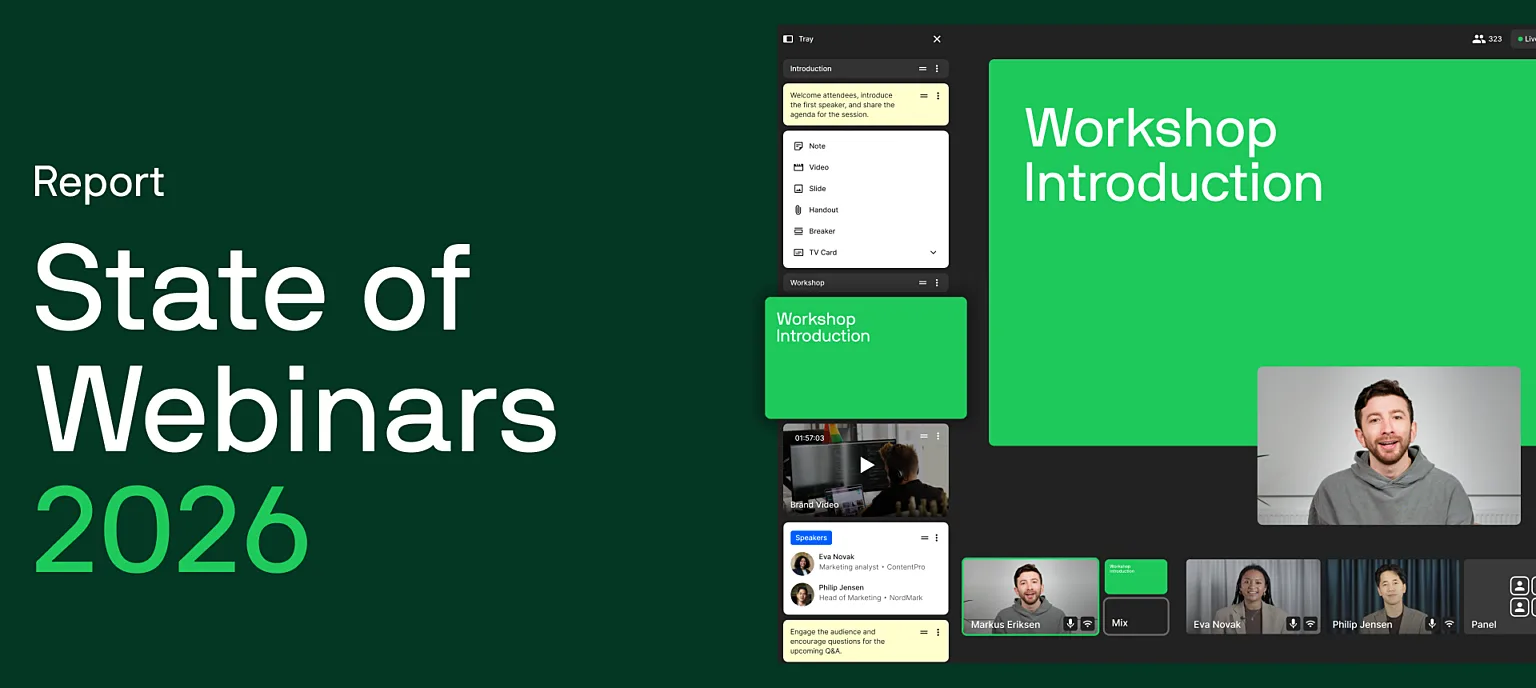
Webinar Statistics & Benchmarks 2026
Scale your webinars with benchmarking data from our annual global survey.
- 308
- Avg. Signups
- 58%
- Avg. Attendance Rate
- 154
- Avg. Attendance
- 3.8
- Avg. Speakers in Webinars
- 63%
- Avg. Conversion Rate
- 19%
- Avg. Ondemand Conversion Rate
The year companies got serious about webinars.
From dedicated teams to content distribution at scale, the State of Webinars 2026 report paints a picture of a rapidly maturing webinar landscape.
Today's webinar is so much more than a seminar on the web: as webinar tools become increasingly sophisticated, marketers can now turn a single webinar into multiple pieces of content with next to no effort.
The rise of the dedicated webinar team, and a near 20% growth in the number of companies integrating webinars into the martech stack, reflects their increasing impact.
This is the year webinars started truly to scale. Dive into the data, share it with your team, and use it to scale your own webinar efforts.
Methodology
This year's report is based on the survey responses of 133 webinar makers around the world. As always, it's supplemented by the anonymised data from the 1000s of webinars run on our platform.
01
Webinar adoption statistics: how many webinars companies run
Endlessly flexible, the humble webinar has become an invaluable tool in an organisation's toolkit. For many companies, webinars are now the default way to get a message out, interact with their audience and even communicate internally.
But while the majority of organisations are now making webinars, there are big differences in the extent to which they're being used.
Start small. Buy a couple of good microphones and some good software. Don't start with hour long productions. 30–45 minutes can be absolutely fine. Don't let the same person produce and host. Those are two different skills, and your team should be able to focus on what they do best. Then you will get the best results.

01. Across your organisation, about how many webinars do you run in a year?
Almost half of organizations run 11 or more webinars a year.
While a quarter of organizations still run only a handful of webinars annually, nearly half now run more than ten, showing how webinars are becoming a structured and recurring part of marketing programs.
Share of organisations
30%
15%
0%
26%
26%
23%
14%
4%
5%
1%
1%
1–5
6–10
11–19
20–49
50–99
100–249
250–499
500+
Number of webinars per year
02. Is this an increase or decrease from the previous year?
Nearly 9 out of 10 organizations run the same or more webinars than last year.
Webinar programs continue to mature across organizations.
In our combined dataset, 45% of organizations report running more webinars than the year before, while another 43% say their webinar output stayed roughly the same.
Only 12% report running fewer webinars than the previous year.
- 45%
- Increase
- 43%
- About the same
- 12%
- Decrease
03. When did your organisation start doing webinars?
Most organizations have been running them for over four years.
Webinars are no longer a new marketing format. Most organizations have been running webinar programs for several years, with 62% reporting that they have been producing webinars for four years or longer.
At the same time, adoption continues. Around 17% of organizations started their webinar programs within the past two years, while only 4% say they have not started yet.
- 6%
- We started in 2024
- 11%
- We started in 2023
- 17%
- We've been making webinars for 2–3 years
- 31%
- We've been making webinars for 4–5 years
- 20%
- We've been making webinars for 6–10 years
- 11%
- We've been making webinars for more than 10 years
- 4%
- We haven't started yet
04. What is your organisational set-up to execute webinars?
More than a third of organizations have dedicated webinar programme managers or teams.
Webinars are increasingly becoming structured programs rather than ad hoc marketing activities.
More than a third of organizations now have dedicated resources for webinars, either through a webinar programme manager or a dedicated team.
At the same time, many organizations still run webinars collaboratively across departments, with nearly half reporting that webinar production is shared across teams.
- 47%
- It's a shared process across teams
- 21%
- We don't have a specific set-up
- 19%
- We have a dedicated webinar programme manager
- 17%
- We have a dedicated webinar team
05. How many people in your organization can set up and run a webinar?
Almost a fifth of organizations have five or more people who can run a webinar.
Most webinar programs are supported by small teams. Nearly two thirds of organizations report that between two and four people are able to set up and run webinars.
Only 17% rely on a single individual, while about one in five organizations now have five or more people capable of running webinars.
- 17%
- 1
- 63%
- 2-4
- 20%
- 5 or more
06. On average, how many hours does each webinar take in total?
Organizations are prepared to invest significant time in their webinars.
Nearly two thirds of organizations report spending between five and twenty hours preparing, running, and distributing each webinar. Only about a quarter say their webinars require fewer than five hours of work.
- 24%
- 1-5 hours
- 37%
- 5-10 hours
- 27%
- 10-20 hours
- 12%
- 20 hours
07. How important are webinars to your overall digital strategy?
Two thirds of organizations consider webinars very or extremely important.
Webinars have become a core component of digital strategy for many organizations. Two thirds of respondents describe webinars as either very or extremely important to their overall digital strategy.
Only a small minority say webinars play a limited role in their marketing efforts.
- 21%
- Extremely important
- 45%
- Very important
- 27%
- Somewhat important
- 5%
- Not so important
- 2%
- Not at all important
08. What do you find to be the most challenging part of making webinars?
While webinars are worth the effort, many organizations admit they're time-intensive.
Traditionally, our respondents say the pressure to host in an engaging way is their biggest challenge.
This year, the time it takes to execute a webinar takes the top spot - perhaps a reflection of the increasingly rigorous approach companies are taking.
- The amount of time it takes
- 33%
- Hosting in an engaging way
- 24%
- Creating content
- 15%
- Finding speakers
- 13%
- Lack of actionable strategy
- 11%
- The video gear setup
- 3%
- The costs associated
- 2%
- Complicated software
- 1.0%
02
Webinar marketing & lead generation statistics
Webinars can help companies achieve many goals, from increasing brand awareness to generating leads and increasing their customer success capabilities. But to do that, webinars must be leveraged with a concrete strategy in mind, which calls for more holistic thinking around webinars and webinar programmes.
Marketing teams still maintain the most influence within organisations when it comes to driving webinar efforts.
Do the positioning piece first, and then define your tone of voice, target audience, distribution mechanism, and subjects to be covered. Then look for guests.
09. What are the main reasons that your organisation makes webinars?
Educating customers & lead generation continue to dominate.
Customer education and lead generation remain the primary reasons organizations run webinars.
Roughly two thirds of companies say webinars are important for educating customers or generating leads. Community engagement and branding also play a significant role, with about half of organizations highlighting them as key motivations.
Partnership building is another growing use case, while onboarding and internal training remain more specialized applications.
- Educating customers
- 67%
- Generating leads
- 66%
- Sharing information with the community
- 51%
- Branding
- 50%
- Creating partnerships and collaborations
- 40%
- Facilitating onboarding
- 19%
- Internal training
- 13%
10. What teams across your organisation are doing webinars?
Sales and marketing teams lead the way on webinars.
Marketing teams are involved in 85% of webinar programs, while sales teams participate in more than 70%. Product teams are also increasingly active, reflecting the role webinars play in product education and launches.
Other teams such as customer success, communications, and events contribute to webinars as well, showing how webinars are becoming a cross functional activity across organizations.
- 85%
- Marketing
- 71%
- Sales
- 43%
- Product
- 32%
- Communication
- 29%
- Account Management/Customer Success
- 23%
- Event
- 9%
- Design
- 8%
- HR / Recruitment
03
Webinar format statistics
While one-off webinars remain the majority, our findings again show a healthy spread in terms of the kinds of structured webinar programmes companies are running, as well as their formats.
Webinars might have begun as ad hoc online seminars to promote a product or share information with customers, but they continue to evolve as more and more companies reap the rewards of a structured approach.
Figure out who will be watching it and create the content they want to see, not the content you want to show.
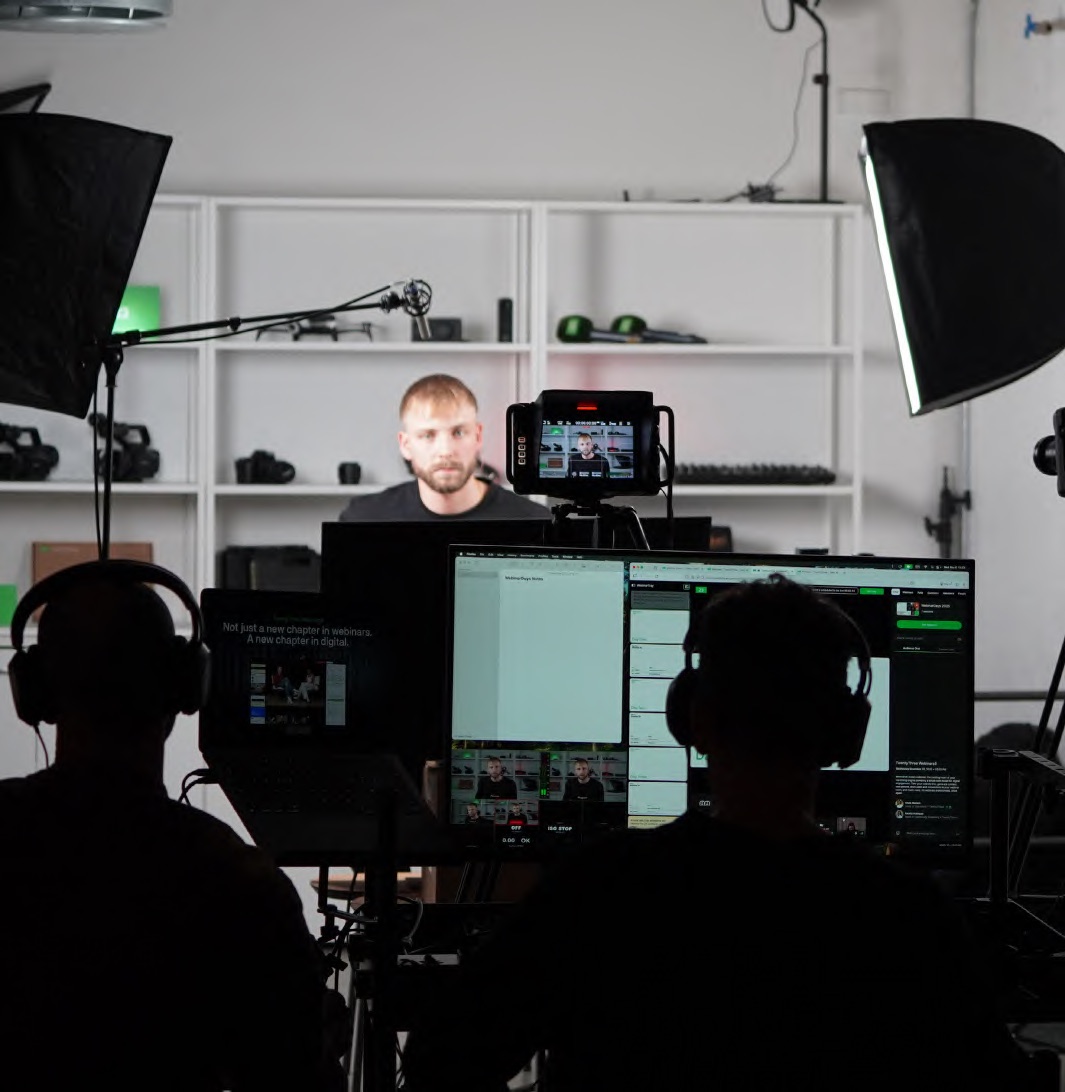
11. What webinar formats does your organisation run?
Many organizations are moving beyond one-off webinars.
Standalone webinars remain the most common format, with nearly nine out of ten organizations running ad hoc sessions.
However, more structured formats are becoming increasingly common.
Almost half of organizations now run episodic webinar series, and nearly a quarter run recurring webinars with the same content on a scheduled basis. This suggests that webinar programs are gradually becoming more strategic and repeatable.
- 89%
- Standalone Webinars. One-offs run on an ad hoc basis.
- 45%
- Episodic Webinars. A series with different content each time, often also runs in seasons.
- 30%
- Online/Digital Events. Longer format with multiple speakers, more of a broadcast event than participatory.
- 24%
- Repeating Webinars. Same content each time, scheduled on a recurring basis.
12. What types of webinars does your organization run?
Lead generation webinars dominate, while relationship building goes untapped.
Lead generation remains the dominant use case for webinars, with nearly a third of organizations using them to capture new prospects.
Thought leadership, collaborative formats, and product focused webinars follow closely behind, highlighting the role webinars play in education and product storytelling.
However, relationship driven formats such as relational and channel webinars remain rare, suggesting an untapped opportunity for organizations looking to deepen engagement with their audiences.
30%
15%
0%
31%
21%
19%
17%
16%
14%
8%
8%
7%
2%
2%
Lead generation webinars
Thought leadership webinars
Collaborative webinars
Product webinars
Webinar series
Customer webinars
Recurring webinars
Internal webinars
Exclusive webinars
Relational webinars
Channel webinars
Data from TwentyThree's webinar tool.
Most webinars happen midweek, but attendance peaks at the end of the week.
Share of webinars
30%
20%
10%
0%
8%
27%
28%
28%
9%
Monday
Tuesday
Wednesday
Thursday
Friday
Days of the week
Attendance rate
65%
60%
55%
50%
60%
59%
59%
64%
63%
Monday
Tuesday
Wednesday
Thursday
Friday
Days of the week
Data from TwentyThree's webinar tool.
Audience engagement stays remarkably consistent throughout the week.
Average viewing time remains consistent across the workweek, hovering around 40 minutes for most days.
Monday sees slightly lower engagement, but the difference is small, suggesting that audiences stay attentive regardless of when a webinar is scheduled.
Engagement minutes
42
38
34
30
37 m
40 m
40 m
40 m
38 m
Monday
Tuesday
Wednesday
Thursday
Friday
Days of the week
Data from TwentyThree's webinar tool.
People are more likely to attend and engage in the morning... but that doesn't mean you should ignore the evening!
Attendance rate
60
40
20
0
62%
60%
54%
57%
Morning 7am–10am
Noon 11am–2pm
Afternoon 3pm–6pm
Evening 7pm–10pm
Time of day
Engagement minutes
50
40
30
20
10
0
42 m
38 m
36 m
38 m
Morning 7am–10am
Noon 11am–2pm
Afternoon 3pm–6pm
Evening 7pm–10pm
Time of day
04
Webinar attendance, conversion & engagement benchmarks
While the number of attendees remains the dominant KPI, we're seeing encouraging signs of strategic intent with webinar measurement.
Perhaps this year's most significant finding is that an impressive 48.5% of companies now integrate their webinar tools with their martech stack, a significant increase on last year and a sure sign of how integral webinars are becoming in the overall business objectives.
Just start today. There is a learning curve, but over time, the webinar program has the potential to bring in the highest quality leads with the lowest marketing investment. Brand it well and integrate it into your CRM and marketing automation from day one.

13. How do you currently measure webinar success?
Attendance and sign ups still dominate webinar success metrics.
Organizations still rely heavily on reach based metrics when evaluating webinar success.
Attendance and sign ups remain the most common indicators, followed by qualified leads.
Engagement signals such as viewing time, questions asked, and chat activity are used less frequently, suggesting that deeper behavioral metrics are still emerging in webinar programs.
80%
60%
40%
20%
0%
87%
69%
57%
39%
37%
29%
22%
18%
12%
7%
Number of attendees
Amount of sign-ups
Qualified leads generated
Engagement time
Views of on-demand recording
Sales or revenue generated
Audience satisfaction surveys
Number of questions asked
Chat activity
We haven't defined success yet
14. How do you currently collect data from your webinars?
Only half of organizations integrate webinar data into their marketing stack.
Nearly half of organizations automatically integrate webinar data into their CRM or marketing automation systems.
However, many still rely on manual exports or built in analytics within their webinar platform.
More than one in ten organizations report not tracking webinar performance at all, highlighting how fragmented webinar measurement practices still are.
- 49%
- Automated. Our webinar tool is integrated with our CRM and/or marketing automation tool
- 28%
- Manual. We manually download CSV files, etc.
- 13%
- Built-in. We use the built-in analytics features in my webinar tool
- 11%
- None. We aren't currently tracking or analyzing the performance of our webinars

Further Benchmarking
- 308
- Avg. Signups
- 58%
- Avg. Attendance Rate
- 154
- Avg. Attendance
- 3.8
- Avg. Speakers in Webinars
- 63%
- Avg. Conversion Rate
- 19%
- Avg. Ondemand Conversion Rate
Data from TwentyThree's webinar tool.
The one hour webinar remains the industry standard.
Most webinars cluster around the one hour mark, with nearly seven in ten lasting between 30 and 70 minutes. Shorter formats remain relatively uncommon, while a small but notable share of organizations experiment with longer sessions.
About 11% of webinars extend beyond an hour, and 5% run for more than 100 minutes, suggesting that some organizations are willing to go deeper when the content warrants it.
20%
10%
0%
2%
4%
9%
16%
18%
18%
17%
5%
3%
3%
1%
1%
3%
0–10
10–20
20–30
30–40
40–50
50–60
60–70
70–80
80–90
90–100
100–110
110–120
> 120
Webinar length in minutes
- 15%
- Less than 30 minutes
- 69%
- About an hour
- 11%
- More than an hour
- 5%
- More than 100 minutes
05
Webinar budget statistics
With more than three-quarters of respondents planning on either increasing or maintaining their current webinar budget, it's plain to see that webinars are now fully embedded as a core business activity.
You don't need to invest a lot of money to start. Make sure to get your team on board and show them the value that webinars could bring. Make sure to set up a strategy before starting.

15. How do you expect your webinar budget to change over the next year?
A quarter of organizations plan to increase their webinar budget.
Webinar budgets appear largely stable heading into the next year. More than half of organizations expect spending to remain unchanged, while about a quarter plan to increase their investment.
Only a small minority anticipate cutting their budget.
At the same time, around 14% of organizations report not having a dedicated webinar budget yet, suggesting that the channel is still developing inside many teams.
- 55%
- Our budget will stay the same
- 25%
- We will be spending more
- 14%
- We do not currently have a webinar budget
- 6%
- We will be spending less
16. What do you expect you'll spend the majority of your webinar budget on?
Companies spend more on promoting webinars than producing them.
Marketing and promotion represent the largest share of webinar spending.
Three quarters of organizations expect to invest their budget in attracting audiences, far ahead of production related investments.
Content creation comes next, while spending on tooling, equipment, or external services remains secondary. This highlights a common challenge for webinar teams: producing the content is only half the effort, while driving attendance often requires the greater investment.
- Marketing and promotions
- 75%
- Creating content
- 53%
- External services (training, consultants, etc.)
- 20%
- Upgrading your webinar software
- 20%
- Buying more gear
- 14%
- Setting up a studio
- 12%
- Growing the team
- 12%
06
Webinar content repurposing statistics
A new addition to the State of Webinars reports, we're asking respondents whether they slice and dice their webinars - create additional pieces of content from the original webinar - and, if yes, what kinds of content they're making.
The rise of content generation speaks to the long-term value of the webinar, and its potential to deliver ongoing results as opposed to one-off spikes.
Ensure you have a robust strategy before beginning, and a stringent follow-up plan to nurture and reengage all registrants for your online events.

17. Do you generate content from your webinars?
Webinars have become a content engine for most organizations.
Webinars are increasingly used as a source of additional content beyond the live event itself.
More than two thirds of organizations report repurposing their webinars into other formats, such as clips, articles, or social media content.
However, nearly a third still do not generate additional content from their webinars, suggesting there is still significant untapped potential in extending the life and impact of webinar material.
- 68%
- Yes
- 32%
- No
18. If yes, what kinds of webinar content do you generate?
Organizations are finding innovative uses for their webinar content.
Nearly half of organizations generate short video clips for social media, while many also turn webinar transcripts into written content or reuse clips across their websites and video libraries.
What was once a single live event is now often the foundation for multiple pieces of content distributed across different channels.
- 48%
- Video clips for social media
- 38%
- Text content from the transcript (blog posts or similar)
- 34%
- Video clips for our website
- 22%
- Video clips for your organization's video library
- 12%
- Video clips to be reused in other webinars
- 10%
- Other
Download the State of Webinars 2026
Webinar statistics FAQ
What is a good webinar attendance rate?
+
A good webinar attendance rate sits at or above 58%, TwentyThree's 2026 global average. Thursday leads at 64%, Friday follows close behind at 63%, and morning sessions, 7am to 10am, average 62%.
What is the best day to host a webinar?
+
Thursday is the best day, with the highest attendance rate at 64%. Friday follows at 63%, despite hosting only 9% of webinars. Most run midweek instead: Tuesday to Thursday take 27% to 28% each, against 8% on Monday.
How long should a webinar be?
+
A webinar should run 30 to 70 minutes, covering nearly seven in ten sessions in TwentyThree's 2026 data. The one hour mark is the industry standard, at 69% of webinars. Only 11% run longer, and just 5% pass 100 minutes.
What is the average webinar conversion rate?
+
The average webinar conversion rate is 63%, per TwentyThree's 2026 benchmark data. On-demand conversion runs lower, at 19%.
Are webinars still effective in 2026?
+
Yes. Two thirds of organisations (66%) rate webinars very or extremely important to their digital strategy. Average conversion rate sits at 63%, and 45% ran more webinars than the year before. 68% now repurpose webinar content into clips and articles, and 48.5% integrate their webinar tool with their martech stack, a significant increase on last year.
Methodology
State of Webinars 2026 was conducted and compiled by TwentyThree.
This year's report is based on the survey responses of 133 webinar makers around the world. As always, it's supplemented by the anonymised data from the 1000s of webinars run on our platform.
The State of Webinars is an annual survey that we run to get a clearer picture of the quickly maturing webinar world.
Using the responses of webinar makers all over the world, the report exists to help you make more informed decisions about your organisation's webinar strategy.
Visit twentythree.com for more information about our webinar tool and more free resources to help you get real results with video marketing and live events.
About TwentyThree
Founded in Copenhagen and proudly independent, we've been empowering the way companies communicate with video since 2005. Created as a hosting platform that gave our customers complete control of their data, we now offer all the tools any company needs to make, manage and share video and webinars.
We believe video is the most fundamentally human way to communicate online and we've made it our mission to put the power of video in the hands of anyone doing business, wherever and however they work.
Designed, Owned, Built & Hosted in Europe
We're a European company to the bone. Not only are we GDPR-compliant, we truly believe in the values of the GDPR legislation and the call for transparency in data processing. A GDPR-friendly product for all your video.

All you need to video enable your whole organisation at every customer touchpoint
We're a European company to the bone. Not only are we GDPR-compliant, we truly believe in the values of the GDPR legislation and the call for transparency in data processing. A GDPR-friendly product for all your video.
All you need to video enable your whole organisation at every customer touchpoint