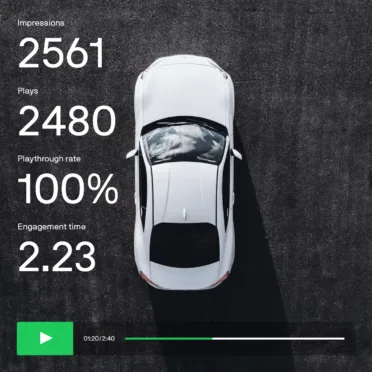
Querying
Ask your video library questions in plain language and get answers straight back. No dashboards, no exports. Just ask and retrieve.
The TwentyThree Agentic Video Release
Welcome To The Age of Agentic Video
TwentyThree is launching the world's first agentic video and webinar stack.
Now you can build agent workflows around your video that query your data, automate webinar creation, and trigger actions across your stack. With support for all major AI coding agents and assistants out of the box, it installs in a single command, so your team can start building video and webinar agents from day one.
The Shift
What is Agentic Video?
Agents are changing how work gets done. They don't just follow instructions - they connect your tools, run your workflows and act on your behalf. Until now, video has sat outside all of that. Agentic video changes it: TwentyThree connects your entire video library and the data behind it to your agents, so they can query, automate and create across everything you've built.
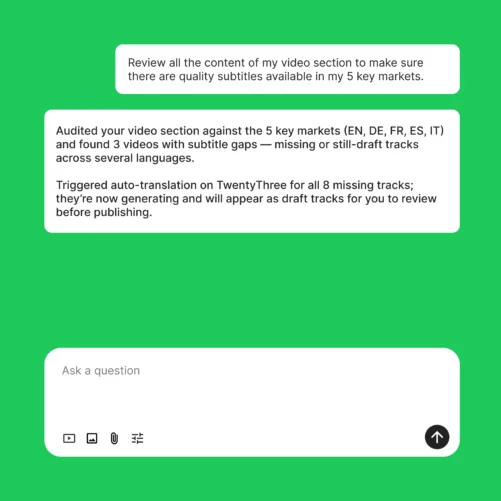
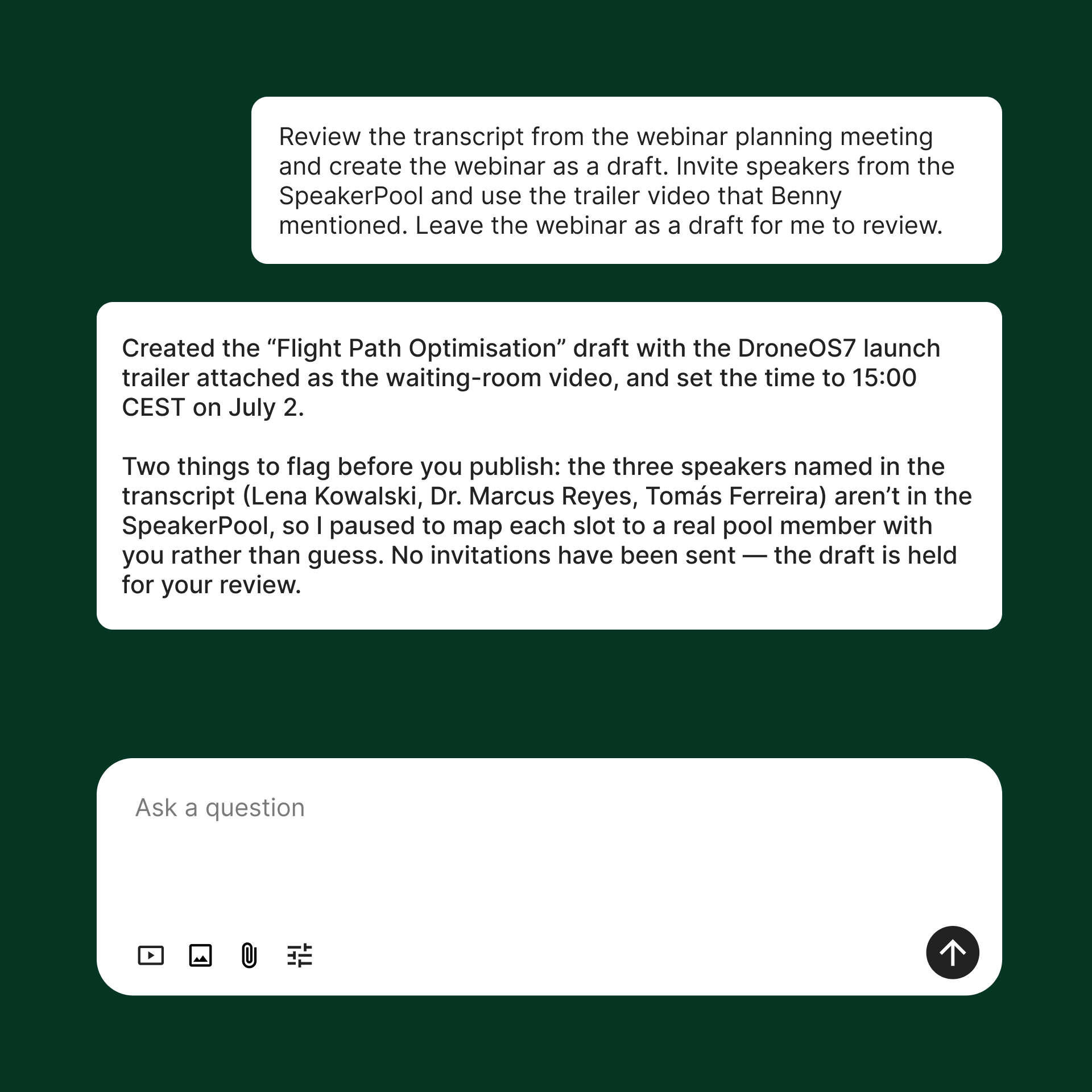
Querying
Ask your video library questions in plain language and get answers straight back. No dashboards, no exports. Just ask and retrieve.
Analysis
Spot patterns across every video, webinar and viewer in your account. Surface what's working, and what isn't, without the manual digging.
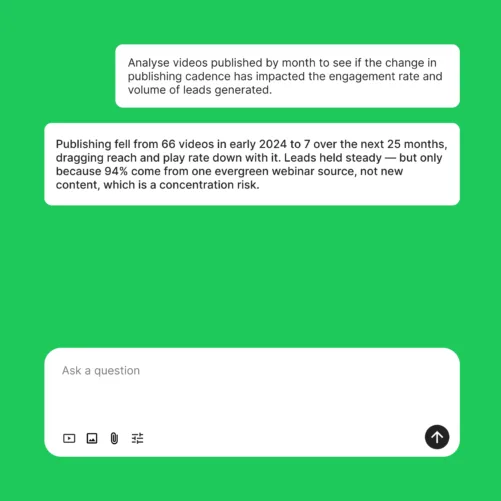
Reporting
Turn raw video data into the reports your team actually needs, on demand.
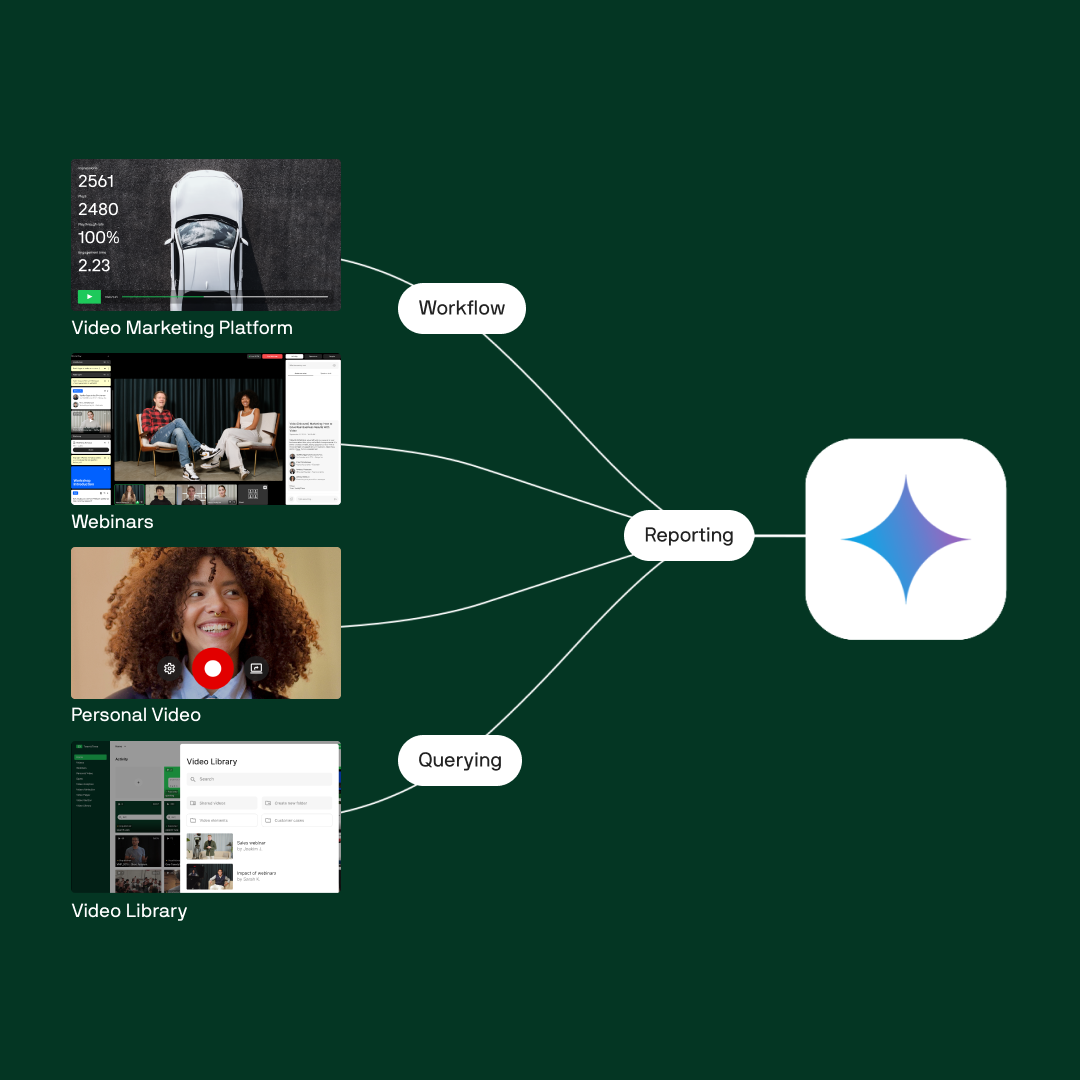
Workflows
Connect video into the processes you already run, end to end, no copy-paste between systems.
Automation
Trigger a new webinar from an action in another system. Audit category usage, generate chapters and keep metadata in order, automatically.
Creation
Spin up a new video or webinar programmatically, the moment it's needed.
Getting Started
Teach Your Agent How to Work With TwentyThree
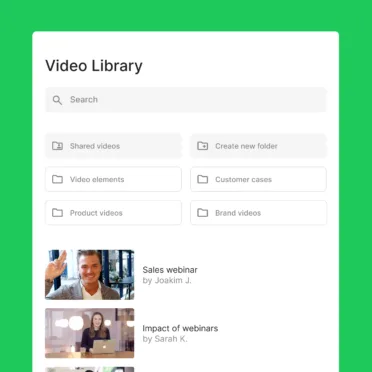
The official skill for TwentyThree teaches agents the structure, the vocabulary and the real workflows of the platform. This means that the agents your team are already working with can reach into TwentyThree: Every video, every webinar, every page and every number behind them.
The engine
Workflows that used to take a small team a week.
Point an agent at your library and tell it what you want. It drafts articles, social posts and email from the words actually said on the recording. It audits what performs and what is missing. It surfaces the moments that landed, and publishes across video, webinar and page. The campaign that used to need a small team and a week, finished by one person in an afternoon. The agent is the power tool. Your team still decides the work.
It's already live in the marketing funnel
Marketers are becoming builders, and Rasmus Leth Skjoldan is already one of them. The CMO of Hello Retail rebuilt his stack around AI and has agentic video live in production today.
Thank you so much everyone. Let's dive right in. So I want to, from the very first moment here, just recognize that we have very different experiences with AI and especially with the new AI coding tools. And we also stand on sort of different ends when it comes to whether you really love the new changes or whether you're super skeptical. So back in November I made the decision that when I saw that the AI coding tools were suddenly good enough to rebuild the entire marketing stack to just go completely bananas. So that's me right there on the right. And I'm going to say that I totally understand if some of you are in a completely different place, skeptical about it, or if you have fear of missing out, or you even know more about this than myself. We're sort of talking to extremely different audiences about this at the moment because everyone's sort of figuring out how to approach this. Yeah, so also two things I wanted to sort of say about my own approach when it comes to AI. I am thinking about the future. I'm fiercely against the idea of the fully autonomous marketing agentic team. I think that only creates incredibly bad quality marketing. As Thomas also mentioned in the keynote previously, there is also a bit of a rebellion starting against synthetic human beings on camera, and I'm definitely a proud member of that. So I'm a fan of S. Devlin. And she has this wonderful quote called, quality has got to win. And in so many ways, that's how I approach the AI stack and the content that we can produce with it. Quality has got to win. So I'm not going to produce AI slop with all of these new tools. As much as humanly possible, I'm going to get to the same level of quality as we did before, or even better, of course. How do you then actually approach building quality or getting to real high quality of content and digital experiences using AI? That's what I'm going to talk about today. All right. Let's take a step back first. There are all of these stories in the media about how many AI projects are failing, especially in the enterprise. Different numbers are sort of floated. But this one is an often cited number of 42% of business AI projects failing at the moment. And I ask my own AI coding tools, so what kinds of, what is the percentage of real live production projects that we have in retail marketing? And it can actually calculate it. So it's a very precise number. And 83% of our projects are in full production, fully live. So I've been thinking about why is that? What happened for us? And I want to take you on a bit of a tour into what happened the past seven months for me and my small team. That sort of got us to this place where all of our AI projects, almost all of them, are in real live production, visible by other human beings, by the search crawlers, by the AI. By the LLM crawlers and so forth. Yeah. So taking a step back again to November 2025, that was really the moment when AI coding tools all of a sudden were good enough for us to scale things up, for us to build real things. So you would no longer get to that annoying stage of sort of getting to 80% quality or something like that. You could actually put things fully into production. And for a brief moment, I was sort of realizing that I was in a real live production. And I thought that maybe if I just speed up like crazy, maybe that's the moat. Maybe I can just sort of outpace my competitors by adopting this incredibly fast. But I think what happened really sort of soon, a few months later, was that all of a sudden everyone's got access to these excellent new AI models. So what does that mean? It obviously means that we as human beings are, again, the operators of technology. And we are the most efficient. Yeah. So ONE attempt. They can take a fully integrated stage now. stack now. So there is a lot. I started by just thinking, okay, I can replace the entire website, which we did in a few months. So there's no content management system involved any longer. It's all done with clock code and GitHub and so forth. And I come from the content management industry, so it was a pretty sort of wild moment for me to just have a fully functioning big website with three different languages, all live, all incredibly fast, performant, SEO optimized, all of that stuff without a content management system. But then immediately we saw we can take this way further than quote-unquote just content management, and it is now permeating our entire marketing operation at Hello Retail in almost every single marketing domain you can think of. I'm sure some of you are pretty sharp marketers yourselves, so you will recognize fast that there are a couple of sort of important marketing domains that are not on the list that we have just not tackled yet. But this is where we got to after seven months. So we're just a team of three, and I was experiencing a pretty sort of typical situation for a marketer that I felt like I was being outgunned by at large. I'm going to show you a few examples of my experience being outgunned by my tier competitors with larger budgets and so forth. Yeah. That was around half of you or something like that. That's a classic situation for a marketer, right? You feel the competitors have more money, they have bigger teams, they are more savvy, they have adopted technology faster, all that stuff. So we are just a team of three, which means that there's one AI lead, that would be me. And two senior marketers, and now 175 systems that are fully sort of live and operational. And this is not to say that you need to be small and lean. Like it was mentioned in the sort of presentation of my talk here, I've worked with very big clients with Tesco, JetBlue, New York Times, Sainsbury's, those kinds of companies in the past, and I so far have seen nothing in this development of our own AI stack that would not have scaled to huge companies. So I can sort of empathise with, you know, you may be thinking, okay, this is just a small lean team and so forth, but I'm entirely convinced that this can scale to bigger enterprises as well. If you don't know what it looks like, this is sort of the marketing UI of 2026 for me. I am staring into this IDE. IDE, the developer's tool set basically day and night, and it's quite a profound change when it comes to sort of the working life for me. All I'm looking at is this, even though I do not code a single line of code myself. I cannot code. But this is what it looks like now, if you're not already familiar with it. Something really interesting has also happened. We're doing far less planning in my small team. We used to have a whole regime of how we did our monthly planning and quarterly cadences and all sorts of stuff. And almost all of that is just completely gone now. We have a lot of discipline around sort of core marketing strategy, which is not about technology, but sort of fundamental principles of good strategy. But as soon as we feel, okay, now we have made the right strategy. We move directly into execution. So there's a lot more execution, a lot more strategy, but far less planning. All right. Just a quick sort of overview of here's the tool sets or the tools that we are currently using in our stack. So what you see on this slide is obviously also that we're not replacing every single point solution. We need a lot of software. But we are in complete. Complete control of the integration between all of these many different pieces to our AI stack. We have replaced a couple of point solutions like the counter management system that we no longer have. But I'm not seeing a future where we're going to rip out all of these different point solution software elements to our AI stack, but we absolutely need them to be integratable into the AI coding tools. All right. So I've been thinking a lot about how come we got to the 83% of projects being live and in full production. And it boils down to intuition or AI intuition, as I call it. And the point is that your intuition that you sort of train and build by using these tools a lot will outlast every AI model. So it's not about sort of understanding the new model and then the new model and then the next model better and better because you're going to be extremely exhausted if you try that. But you can be conscious about how you train your own intuition in terms of how you use these tools. And I'm going to talk a little bit about sort of our experience at HoloRetail about how we have sort of come to that point where we feel like we're not going to be able to do anything new. not about sort of just rational planning of how to use the tools, but we can actually sort of sense when something is going wrong or we can get to a point where we feel, okay, the AI is doing the right thing, just accept and go as fast as possible. So over time, what I've come to experience is that the more I sort of sense, okay, the AI is on sort of the right path here where it's not, the faster I can move. And I've been thinking about what does it take to sort of instill that in a marketing team? Because it's not just about one sort of AI dude. It's about operating the entire thing, of course. You need to sort of figure out how do you install this team wide, no matter whether that's just a couple of people in my case or a much bigger team. And I've been thinking about AI intuition sort of on a team level or an organization level. What does that actually mean to get to that level where you can move incredibly fast and where you can get real AI sort of driven projects live super fast? So, first and foremost, repetition does matter. You do need to sort of get the reps in. There's no doubt about that. That's a really no-brainer one, easy one. But here's where it gets more interesting. You also need to get sort of into a lot of variation. You cannot just have a specialist and sort of have them sit over in the corner and hyper-optimize one single part of a process with AI. You're not going to get that. You're not going to get to sort of proper AI intuition or speed if you try to do that. You obviously also need to maximize distribution of AI usage in the organization because intuition does not come by just watching others. I'm not a fan of centers of excellence around AI. You need to mainstream it in the organization quite clearly. Also, reality has got to hit you in the face. You have to sort of be able to do it. You have to allow your team members to experience what it means when they deploy something with AI that is not going great. Your brain really needs consequences to sort of learn quickly. So that's a really important point for you as an organization to be open about, that you cannot sort of do the extreme degrees of risk management or you will get nowhere. Also, the fifth one that I wanted to sort of call out is extremely important. It's extremely easy to build stuff with AI that fails without you realizing it has failed. I don't know if you guys have tried it, but it happens sort of all the time. You're building and building and building, and then something is sort of failing in the background. You've forgotten about it, and you're not really noticing that all of a sudden a part of your site is no longer live, for example. So you have to ensure that you're getting extremely loud notifications no matter how you organize that. All right. So I also wanted to sort of be open about a little bit of a confession here about what does not work and why. So what actually happens when I cannot spot the AI's mistakes myself, that definitely happens to us in ad operations. That was a pretty sort of painful experience. It's not that it's not working, but because AI operations is not my own sort of personal strength. I wasn't able to easily sort of guide the AI to do the right things because I didn't have the expertise myself. And I do think it's a very fair concern that many have that what do sort of junior, younger people do that do not have the domain expertise to sort of throw into the AI what are they going to do, which is definitely a challenge. All right. I want to talk a little bit about how we sort of more practically. Do this and also how we have used the new AI features from TwentyThree at Hello Retail. We are a Danish software company, 55 people. We produce e-commerce software, agente commerce products, that kind of thing. So back in 2025, we wanted to first and foremost do a rebranding. We really needed that. Old stuff was getting sort of dated. The usual thing. And we decided to go for sort of the economist inspired messaging, use of color that would really stand out. And we also wanted to adopt much stronger use of video. And we launched this new product called Product Agents, which is the perfect case for me to show you how we've taken advantage of the new AI features from TwentyThree. Yeah. So this is sort of the example I want to show you. We're taking the AI transcripts from the TwentyThree platform, the AI generated transcripts, and using them to turn a video into chapters. Nothing sort of very special about that. That's been possible for some time. But where it gets really interesting is that we are also taking that transcript, feeding it through our SAP. blog posts about every single chapter of a long video. And that happens with very, very limited sort of touches by us as human marketers. So once we are really satisfied with the quality of the base video content with real human beings on with interesting original things to say, we can immediately create a very rich SEO and GEO or AI discoverability content out of that through a managed agent running on Cloud. So if we sort of just go into the TwentyThree UI, we get the transcript, and then we publish that on the website. Pretty standard stuff. But what gets really interesting is then the blog post. Because this was an hour's work. An hour's worth of video that immediately turned into a whole schedule of eight blog posts with a video embed at the top and a full text about the topic of the chapter or the section of the video. That is completely agent created. We just sort of do a bit of checking and making sure that the quality is really good. But so far, we've gotten to a point. Where it is actually possible to get this stuff live and in production and at really high quality. We're now also experimenting with completely new ways to surface all of our video content. So based on these transcripts, it means that we can sort of summarize what are the themes across all of our videos, across the webinars and our release videos, our conversations format. Take all of those chapters from all of those different types of videos and start grouping them or tagging them automatically, which we can now do through the new AI features on the TwentyThree platform that Stefan and Thomas mentioned. So it means that you can sort of create richer experiences using video on the website across different formats that are tagged without us touching anything, basically. Yeah. So to summarize, since I know you have not been exposed to sort of the AI features yet, but you have to think about it this way. That the new TwentyThree AI features, they sort of teach Claw Code or one of the other AI coding tools how to operate the entire video library. And you can do some pretty fascinating things when you start thinking about how can I piece that together with our other tools. Because you're not sort of just a video specialist. You're a video specialist that goes into the video platform and then you sort of do your thing without fully knowing the context of the full picture of how is our content performing on Google in Google Search Console or what does our Google analytics say about different pieces of content. How can we use it in our ad operations through things like the LinkedIn advertising API. So all of a sudden you're able to sort of stitch everything together and as a marketer, think about the audience. The audience's experience instead of having to do this enormous piece of coordination work that is otherwise needed with like platform specialists that need to be pulled in and you need to coordinate all of that work. If there's one thing that can really frustrate me as a CMO, it is when that coordination breaks down. Because of how hard it is to get all of the different people and tools together in a room or whatever it is that you're launching. And this completely changes that. Completely. I've not experienced all of this sort of the typical failures of handoffs and coordination after we adopted this stuff. So I also want to talk a little bit more about what's called the third audience. So for a couple of decades, we've all been optimizing for humans and for search. And AI is now obviously a third audience that we need to sort of treat as a first class audience in our tool stack and with our contents. What we're doing also with video transcripts is that we're sort of exposing more content to the AI crawlers than the human beings will get. So you as a human being going through a browser experience of our website, you'll see one thing. But the LLM crawlers will not. You'll see something quite different. For example, we're taking the entire transcript that I don't think would make a lot of sense to sort of put in front of the normal user. But it does actually make sense to put it all in there for the LLM crawler. So if you write sort of .md after the normal URL, then the LLM crawler will get the entire thing. Which is also originating from the TwentyThree AI transcripts. Yeah. So I've been asking myself, is this really that different from what we were able to do before just with developers? And in many ways it's not. I've also had sort of developers in a marketing organization previously where we would task them to do things like creating these different views of the video, for example, to do really smart cross channel usage of video. But the whole point here is that I can now link that directly to strategy choices. And that is so difficult to do at scale if you're relying on handovers, coordination, briefs, understanding of what the purpose of a campaign is, all of that stuff. So the change or the really new thing for me is that link between execution and strategy. And so for me... Okay. So the experience of using this stuff, also the TwentyThree agentic features, goes like this. One session can be maybe an hour and a half. We'll end up outputting an indexed video library, for example, six blog posts, a lot of optimization, internal sales clips, catalogs. All of that stuff is basically done by myself through AI coding. So... Okay. If we elevate the perspective a little bit, this is fundamentally what has happened to our work in our marketing organization. It used to be a ton of coordination, a ton of planning, all of that stuff in the middle, sort of liaison work in between the different teams and stakeholders and tools and integrations. And now that is just completely compressed to like a thin line in the middle of, on one side, a ton of AI and automation work. Okay. And AI coding. And then on the other side, all the things we love about human marketing, being present at events like today, doing real video work with, you know, interesting human beings having something important to say, being out there with your partners, going to the restaurant with them. All of that stuff that will sort of give you a different level of reach into the markets and the audiences you want to get to. But planning is basically possible to almost eliminate. Right. So if there's one takeaway from this talk, I'd love to sort of inspire you or welcome you to think about this. How can you sort of do whatever is needed to get to very high levels of what I think It means a whole lot when you're actually putting this stuff into motion. And your AI intuition, as it builds and you get more and more comfortable using these tools will just outlast all of the different models that you're trying out if you're into AI coding at all. With that, I think LinkedIn's absolute best feature is direct messages. All right. So I'm going to stop sharing all of the other stuff I don't like so much. But I do actually love having real genuine conversations with people through DMs. It's wonderful to be able to do that with sort of like-minded people working on similar stuff. So you are absolutely welcome to say hi. And you can also check out some of the stuff that we've done with AI on the website. Thank you. Thank you.
Watch: It's already live in the marketing funnel
Rasmus Leth Skjoldan spent thirty years in digital, then started coding every day with Claude. Over seven months his team at Hello Retail rebuilt its marketing around AI, connecting their whole stack instead of waiting for software to add a button. With early access to TwentyThree Agentic Video, they are already in production: turning full-length videos into chapters, working from the transcripts, and serving markdown files straight to the LLM crawlers. Not a pilot. The live website.
Book a demo
See for yourself why every day, more and more of the world’s best webinar program managers, video producers and marketing leaders upgrade their companies to TwentyThree.
One of our Video Marketing Experts will be in touch to give you a tailored demo.
Companies that take video seriously upgrade to TwentyThree
All you need to video enable your whole organisation at every customer touchpoint