Turn on advanced AI enrichment
Switch it on once and the engine goes to work across your entire library — continuously analysing every video and webinar so nothing sits undiscoverable.
The TwentyThree Video SEO & GEO Release
Search is changing. Have your videos and webinars lead the change.
Searching and being found on the web has never been harder. This makes your perspective and your storytelling from videos and webinars matter even more.
With this release we're bringing in a whole new way for your videos and webinars to be visible and discoverable on search, on chat and by AI.
The shift
Search just changed for the first time in 25 years.
Google just announced its biggest change since 1998, from a page of links to a single answer. Ask Google, and an AI decides what you see. The next decade won't be won by whoever makes the most content. It'll be won by whoever is telling the stories that get found, cited and recommended.
What is GEO?
Generative Engine Optimisation is SEO for the answer engines. Where SEO got you ranked, GEO gets you cited, included and recommended inside the answers that ChatGPT, Claude, Perplexity and Gemini write for your buyers. Same foundation as search: structured, text-supported, machine-readable content. And the engines are hungry for exactly the kind of video your team already makes – original, human, event-based. Not commodity text anyone can generate. The real thing.
Advanced AI Enrichment
The AI engine that optimises videos and webinars for search
We built an engine that optimises all your videos, webinars, pages, Spots, categories and WebinarSeries for search and discovery. Where a video has no transcript, it writes one. Where chapters are missing, it proposes them. Where titles, descriptions and keywords are weak, it drafts SEO-ready copy from what the video is actually about. It runs continuously, so the longer your content lives on TwentyThree, the more discoverable it becomes.
Turn on advanced AI enrichment
Switch it on once and the engine goes to work across your entire library — continuously analysing every video and webinar so nothing sits undiscoverable.
Automatically transcribe your videos and webinars
Every video and webinar is automatically transcribed, giving search and answer engines the text foundation they depend on to read, index and cite your content.
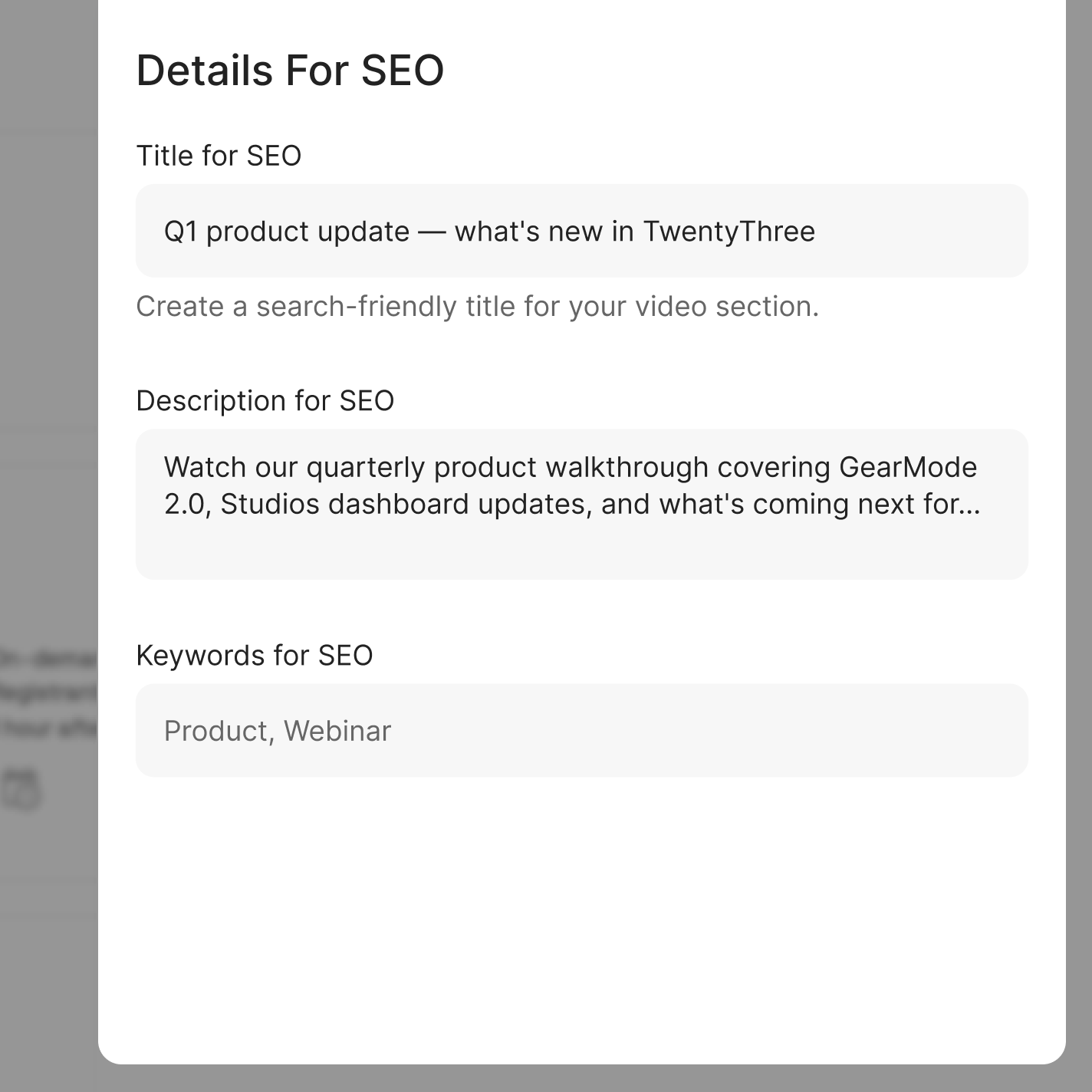
Suggest SEO and GEO copy from your content
Titles, descriptions, keywords, chapters and transcripts are drafted from your real content, ready to review, approve and ship.
Upgrade with chapters, summaries, trailers and bios
AI proposes chapters and summaries that make long content skimmable for people and parseable for machines.
Search Readiness
Stop guessing what's ready to be found.
You can't optimise what you can't see. The new Search Readiness Score in TwentyThree tells you how discoverable each video and webinar is, and exactly what's holding it back.
Across a library of thousands, video SEO is now finally something you can measure and manage.
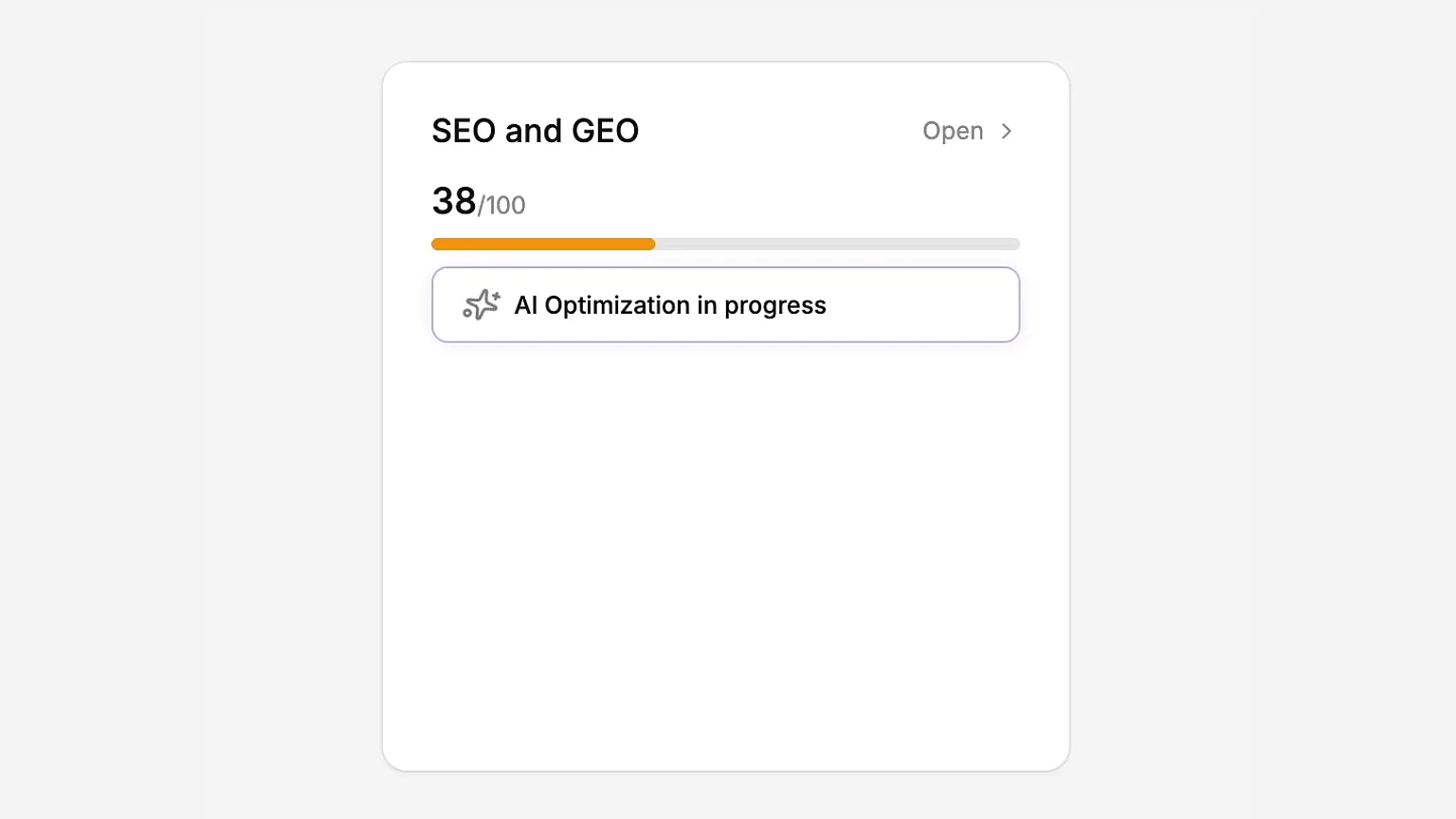
A score for all your content
The readiness of all your content is rated from 0 to 100, on every video and webinar, so you always know where you stand.
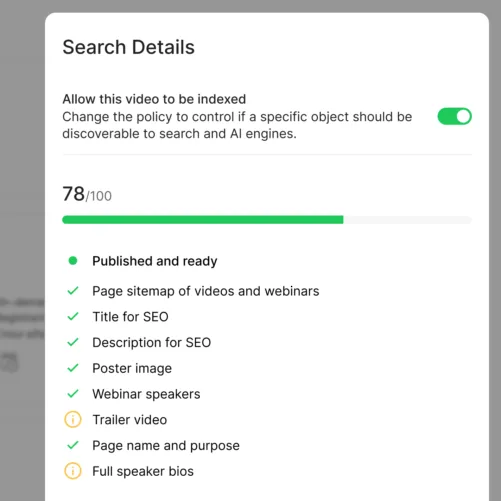
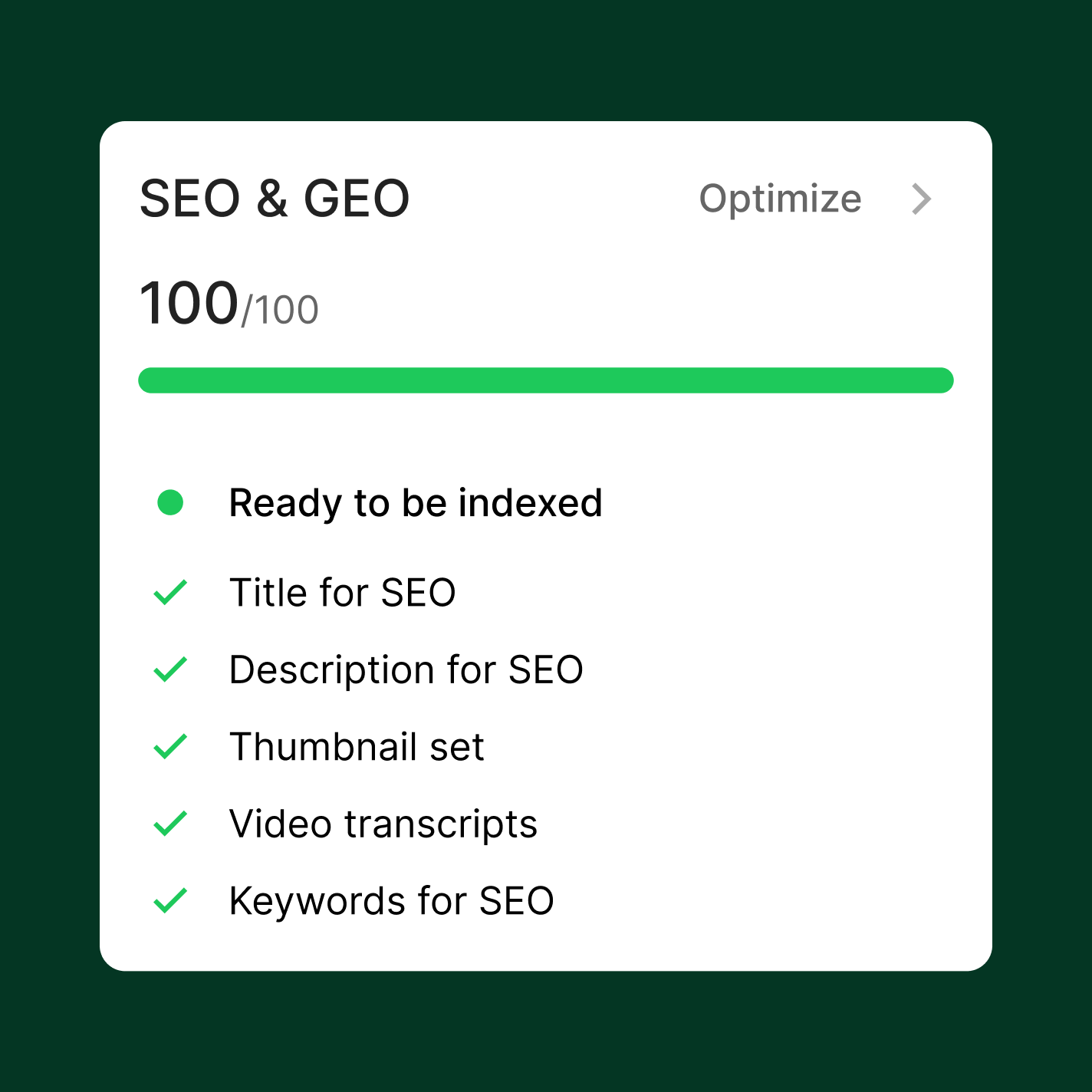
See exactly what's missing to rank
You'll always know what to fix to succeed. A missing transcript, a weak title, a thumbnail that never got set.
Also optimised for webinars
Webinars capture expert insight, buyer questions, product education, use cases, objections, and real-world context.
SEO Controls
Optimise every video, webinar and page, all in one place.
Your content lives across video sections, webinar hubs, landing pages, Spots, registration and on-demand pages, so that's where optimisation belongs. Every searchable object now gives you full control of SEO and GEO.
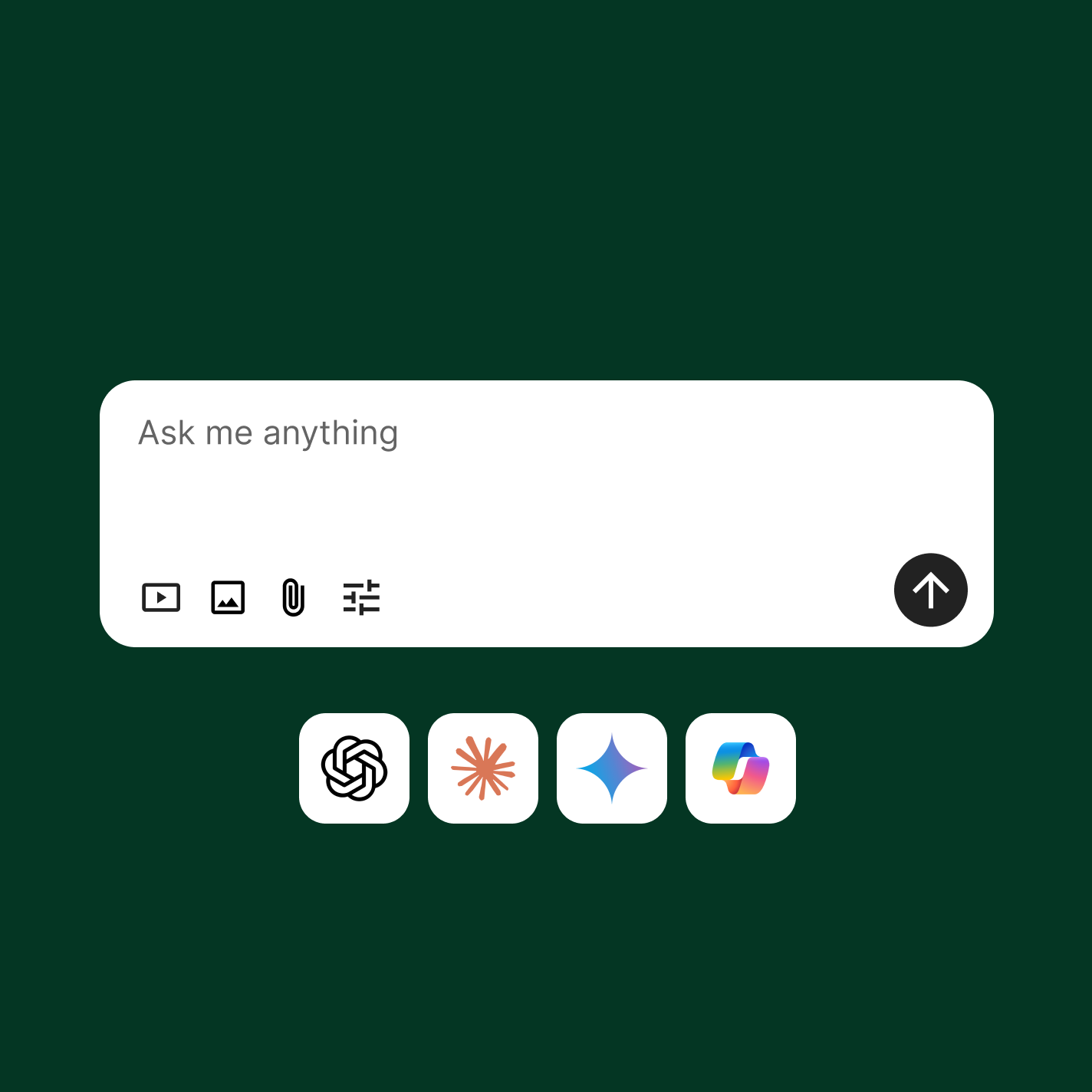
Open up to the answer engines
Video made by real people is exactly what the answer engines are looking for. When you switch on AEO and GEO indexing, you will give ChatGPT, Claude, Perplexity and Gemini something worth citing.
Follows your video player
Your optimisations for search and for answer engines travel with your video player and your Spots. When you embed videos across the web, your perfect thumbnails, summaries, chapters and transcripts will travel along.
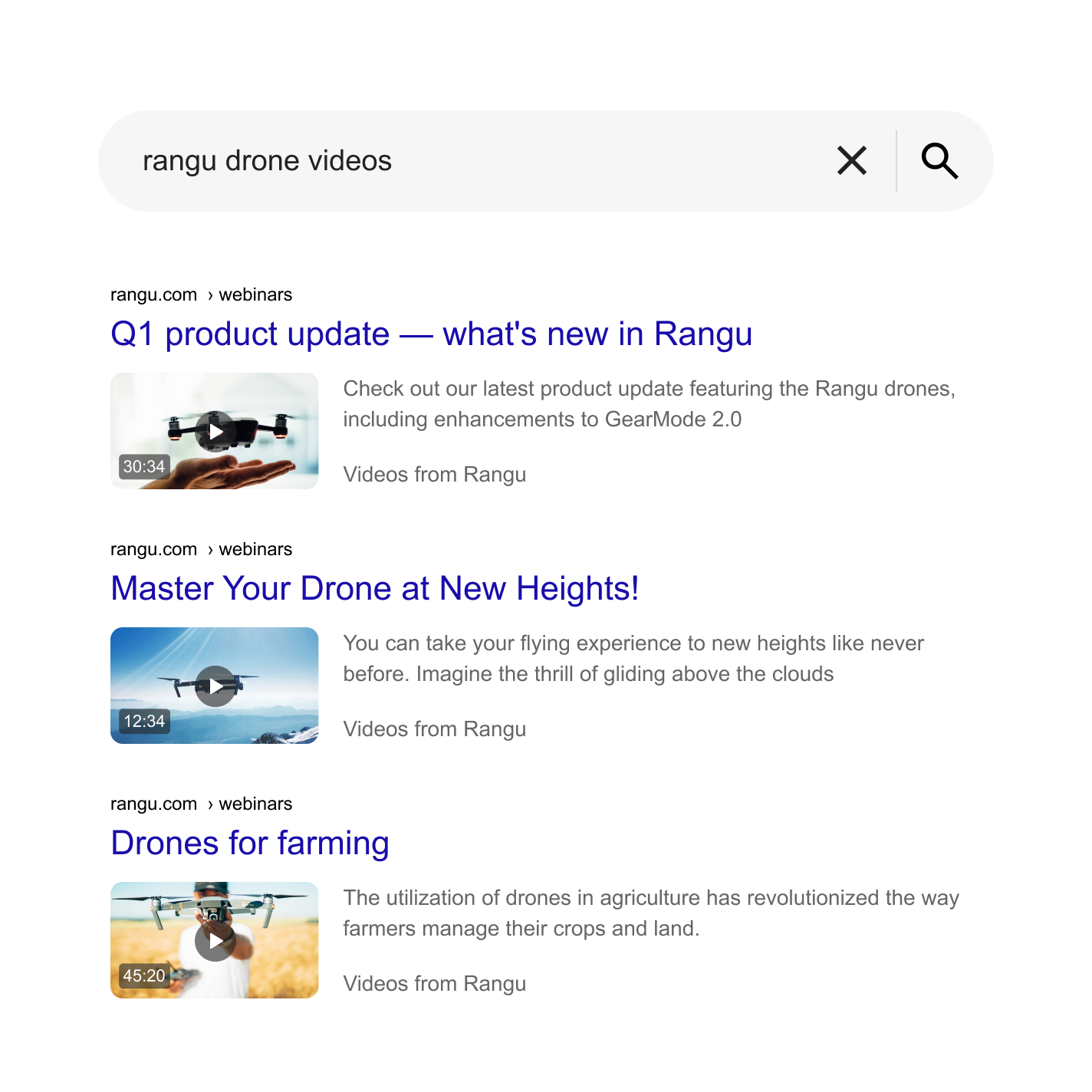
Control what search and AI engines see, without code
Discovery now runs underneath your whole workspace with fine-grained control over indexing policy, structured data, video sitemaps, and editable robots.txt and llms.txt files.
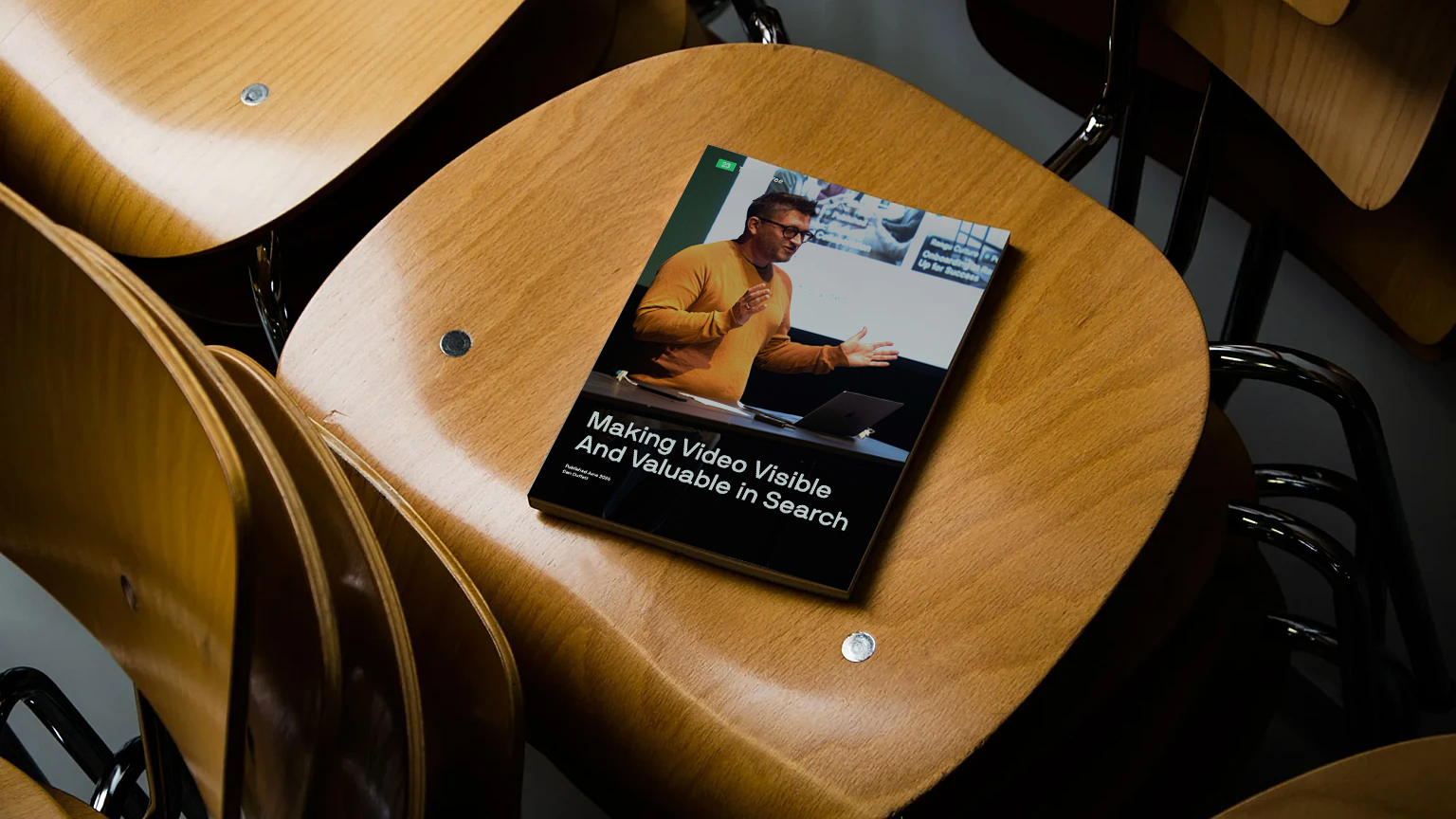
Your best-practice guide to video SEO and GEO
Download our detailed guide covering the technical, content, architectural and operational layers of getting found in the AI age, and why webinars are the most durable search asset you own.
Hello everyone, it's so great to have you here. I'm very happy that the room is almost full to listen to a technical, mostly technical presentation. My name is Andre, I am the founder and the lead strategist at PageRater. We are an SEO and GEO agency that helps companies get found online. I started doing SEO around 30 years ago almost, so I did my first website when I was in 96, so when I was at university. And I've been very happy to follow all the evolutions of the web and being able to basically help companies get that evolution. And I'm very excited to be speaking here today because I think video is uniquely positioned to take advantage of what is this new AI web. So I'm very happy to talk about that. I hope we have a good conversation. I hope we have some time for Q&A at the end. I've had already some important questions and I would love to clarify anything that you have in mind. Okay, so let's start with a question. Who knows what this is? And it looks like something that we already know, but it's something slightly different than what we already know. Anyone? Google's new Google AI. It is exactly that. So Google last week announced the biggest change that they've done to their main internet. What this means is that the thing that we used to use has an input to search something on Google. It used to say something like search Google and now says ask Google. It's a change of paradigm. It's a completely different way of interacting. Of course, you still do questions. But what is designed for is that you have longer questions, the same way we are using AI today and ChatGPT. We don't ask for rooms in burrows. We don't do that, right? So we ask for more complex questions. The other thing about this that is very relevant is that we used to basically query only with words. And now this is multimodal. So basically we can use speech. We can use video. We can use multiple forms of input to get what we want. I'll tell you an experience. For me, the way I use, for example, I'm actually living in Japan right now. And I don't speak Japanese yet, unfortunately. So every time I go to a restaurant and I need to understand what I'm going to eat, I use a form like this. I've been part of the Google Labs experiment for a while. So what I do is I add the menu via form like this. And I get an output that basically translates that and tells me what I like to eat. More than that, because it knows a bit about what I do, it's actually giving me recommendations based on my profile. Which is at the same time a little creepy. But, you know, stay with me. Okay? The reason I'm also showing this is because I'm not a professional. And you can see this slide is that this is going to have a big impact, of course, on all the content we're going to produce in the next few years and all the content we already have. But I think video is uniquely positioned to take advantage of this change. Okay? Let's first understand where is video now? What is happening? We all know that video exploded. Video is everywhere. Video is on all the different platforms, TikTok, YouTube and everything. But from an SEO perspective, a search engine optimization perspective, what is actually happening right now is, what is actually happening right now is that YouTube and other sites are actually taking 95% of the real estate on Google. So if you search for something on Google and you have a video that is on your website, the chances of your video showing up on Google is actually only 5%. And the reason, of course, that is happening is that Google doesn't want you to be on your own property. Google wants to keep you more and more on their property. And we're going to see that it's going to be even worse in the coming weeks and months and years. And this has been happening for a while. And so there's this amazing quantity of content that is produced in video that is actually hosted on platforms like 23 and other competitors. And that is simply not available, simply not visible. You know, you guys spend hours and hours and hours producing this content. The content has, you know, 10 views, 20 views. And not only maybe if you published on TikTok. You would have some visibility. But then our YouTube. But then you have the other problem is that you don't control the channel. You don't control the leads. You don't control the brand. You don't have any of that. So today we are here to talk of how do we make video work on our websites to bring so that we can control the brand and that we control the leads and we control the whole experience. Okay. So why are videos not available on, you know, why is Google not showing those videos? Why do LLMs have a problem with showing videos? There's actually different systems have different challenges. In one way, Google cannot watch videos. So if it's a video file, Google doesn't know what it is. It doesn't have enough signals to understand. Google is an indexer. It's a search engine and they need text. If they don't have text, they don't know what to do with it. So the way, of course, YouTube is also kind of being favorited to be shown is because they have transcripts and they have all this information around each video. And I will explain later. Okay. How we can do that on our own site to our own videos using 23 or directly, you know, on our own. So Google doesn't understand your video. If it's only a video file, it doesn't know what to do with it. Uh, LLMs are even worse for LLMs. What they need is a blob of text that they can process and they can do all the complex stuff like vectoring and indexing and all that. So every time a page has a video in better LLM, see that has a blob. It says code. They don't understand. They cannot. Process. Uh, we used to say that Google could not read JavaScript. Google reads a lot of JavaScript compared to what LLMs can do. LLMs do not understand JavaScript to not, at least at this moment, they want to index text so they can process and they can do all the, all the calculations for that. Okay. Uh, and of course that makes it, uh, very difficult for, uh, technically and in terms of content and everything very difficult for, for content to be explored. You know, it's just not visible. Discovery is broken. That video is not visible. Uh, but of course that's also the opportunity. If we're able to fix that little thing, again, we go back to the idea that we can get all these content visible, but can we do it? Let's, uh, let's talk about a little bit more of, of how, how search is changing and discovery is changing. Uh, of course, I don't know. I'm actually going to ask that how many people use a chat GPT or any sort of, of, of LLM on a day to day basis to, yeah, exactly. This is why Google. Is making the change that I just showed earlier. Okay. Uh, the number is massive. Uh, almost a billion people every week using chat GPT is growing two times, three times per year. Um, uh, Google did the presentation and Google of course is, is, is also making the same kind of, uh, uh, same kind of numbers. They just announced something like a billion people, uh, seeing AI overviews when they do searches online, the numbers are staggering. There's no, we can say, oh, maybe the world wouldn't go with that. That it's going, you know, it's not. The world is changing. The world has changed. Okay. And we have to design for that new world. And I'm going to explain a few things of how, how we can do that. Okay. Um, and of course the opportunity again is to make people, uh, to make videos visible in the platforms where everyone, and here in this room, everyone said yes. So where everyone is searching and there's ways to do that. Okay. Um, so how do we make a video? We start us, you know, answering the question, how do we make video, uh, appear on these places? Um, and I think the answer of course is. Video SEO or video with geo. And, and I think we have to put this in, um, um, I would call this a framework, but I, we have to put this in a way that we can actually process it. Uh, video SEO has three jobs. Uh, the first job is to answer, uh, we, we need to help LLMs and Google answer the question, you know, can you find my video? Definitely, you know, fine. Maybe they don't even know that the video exists. Okay. Uh, and, and there's very specific ways that we can do that. And we'll see that in a, in a second. Uh, the second point is, um, is your video discoverable, but can Google and LLMs understand what is it about? Who produced it? Uh, who are the speakers on the video? Uh, what is something that I'll mention in a second? Also very important called intent. Now, is it a video to do a how to, is it a video that is, that is a sales process? Is it, is it, what is it? We need to be very specific, uh, about. Uh. Not only making the video that it has an intent, but then making sure that that intent is translated. And I'm going to use that word, not translated in terms of a language, but translated in the, in the sense that the video need to be understandable in text and in categories and in links. Okay. And that's very specific that we can do that. And then I would say the third point, uh, which for me is the most important. And it's very interesting that throughout the conference, we've been having this discussion about brand and about trust and about, uh, all of, all of these things. And. I would say that the most important. Uh, when we're talking about AI is to have a content that is trusted, uh, no, no matter what happens, no matter how, how much content we can produce in the next few years, if it's not trusted, it's not going to be visible, even if it's discoverable and it's understandable. Okay. And again, we're going to have a way to, to understand how, how that, how that happened. Um, another very important point is why do I believe that video, uh, is, uh, an amazing asset that we can use for, um, it is actually. It's actually uniquely positioned, uh, to be, to, to, to take advantage of this new, uh, AI world. Uh, my first point is that, uh, video is proof of, uh, expertise. Um, there's no way I right now that can do, uh, that can get the same value that we have out of a webinar of someone from a company, a product, a product doing a product demo to customers. Uh, webinars have another advantage where sometimes there's Q and a Q and a is a lot of value. There's a lot of the object. Uh, uh, objections that people have to buying. Like if someone ask you about a video, how far would we go? Well, it's work actually, because um, you, you just motioning from the Mac to dot, let's say you can like pick shit off, just slash off, like if you want to. important called expertise and expertise is one of the big validators of if your video can be trusted or not um the way seo and geo works and so far seo up to now and now of course geo is that uh you could write any anyone can write any article around the world about any subject so i could go on and write an article on open heart surgery you know which i have no idea about of course and i hope i never do but you know the thing is i could write that but the way google already worked right now is that if that article is signed or it has something that says it was written by a surgeon and that surgeon has a linkedin profile saying that he's the author of many papers on that area and he's been working on some sort of of hospital in the in that specialty for many years that's a validator that that article is more important than it is if it is some guy somewhere around the world that decided to use an llm to say open heart surgery is done this way you should follow these 10 steps you know it doesn't work that way and and and google and llms are very good at detecting already that sort of authority in the context of video and the videos that we are talking about in this in this event it's already built in those are already those are you're already the the guy who created the product you know you're already the guy the ceo of the company who was explaining the product that he had the vision two years ago to build so that's already by default there okay so that's number one on why i think video it has a big advantage and the second one is proof of reality uh think about this this event uh all of the content that is being produced here is being produced by real people speaking on stage you know people being interviewed everything that is here is about it's real it's about humans and again we go back to the thing of trust in a world where anyone can produce any video anytime using generative ai yesterday in this room there was an amazing presentation on that but it's a different context if you're trying to pretend to be human and and there was also another presentation about the idea of pretending to be human if you do that google is going google and the other llms are going to to say this is not trustable you know we're gonna trust ai because you know they don't trust ai they're not going to trust that but video in this context is uniquely positioned to actually validate the idea that it's made by humans and i actually believe that you know of course with all the ai being produced right now and all the deep fakes and all this very big problem that we have right now there is going to be increasingly processes to kind of verify that video is made by humans and and i don't know if you if you know that but uh there's some camera camera uh camera companies discussing the idea of putting on videos like real videos by made by the camera the idea of putting like a blueprint that says that the video was actually filmed on a camera and and and and going a bit on on the geeky side you can even use something like blockchain to guarantee that that information is that the whole you know the idea is uh we need a reality and and right now before we have those systems that can verify that what is what is already happening with google and llms is that if it's made by human if it's made by by by this proof of also expertise uh we're going to have this unique advantage that most people who are trying to generate content don't have and here again we have an amazing quantity of content that we can use for that okay um the third point is uh as of course the platforms are already rewarding that as i was mentioning with the open heart uh example uh you can already do that like if you write an article tomorrow and you say i am the author and i'm an expert in this area and i can i have proven experience all of it is already happening google said uh i think uh two weeks ago uh it said that it's not interested in in a in a in a conference in the u.s it said it's not interested in commodity content video exactly it works exactly the opposite it's so hard to make a video it's it's so so time intensive that you don't want to make commodity content you don't want to make a video by default that says the same thing that someone else is not reading an article and saying the same thing that someone else do so it's uniquely positioned to do that of course we need to make it discoverable and understandable all that uh but there's by by design it's almost like a structural advantage to video that most of the content online right now doesn't have okay um and of course the last point we've been talking about this uh in in many different contexts but uh it is almost impossible even if it's possible to generate a webinar with q a and everything who wants to do it you know for what reason and and if at some point we can we can we are we are as a presentation showed yesterday if our brains are already shutting down when we think it's an ai our brains are shutting down when we think the video is too perfect when even when it's real so and it was a great presentation yesterday on that uh on the by lev on that on that subject so uh uh i think it's really one of the big advantages uh while i was doing this presentation um i i already believe this and i've been doing some work with 23 for a while on on some of these uh areas uh but but having done so much work with seos in in in the in the in the last 25 years it's it's been really effective in making sure that openings like this nothing will be answered the question but the thing that i really struggled with that we want to get to is those other something very, very important, which is, this is very controversial what is written there, but I actually think right now with what we know right now, GEO is 90% SEO. And what does this mean? What this means is that everything that we've been doing in search engine optimization, so optimizing for this algorithm that already had anti -spam and it was looking for authority and all that works to get ranked. And there's proof. There's many studies that show this, but there's a specific study by this guy called Ben Wills that showed that there's a direct correlation between being ranked on Google and having very trusted backlinks and having a page on Wikipedia and being listed on Reddit and on all this. These are all things that we as SEOs who do SEO. For a company in the past, we would tell people to do this. So actually, if you do this already, you have a higher chance of showing up on LLMs. And you can see that there's actually a big number. There's almost 80% of AI citations, LLM and AI overviews come from pages that are already on the top 10 of Google. It's almost like a signal that if you know that your page is there, the chances of you being listed on LLMs is higher. So if you're not even on Google, then working for LLMs is like almost a next step. The second point I would make is that, yes, Google still dominates. Google has like 85% share of traffic and people who are sharing there. And at the same time, AI, both AI overviews from Google and ChatGPT and all the other LLMs are sending right now less than 1% of the traffic to websites. And this is by design. What is actually the happening is that LLMs are designed to have a summary of the thing that you are searching and keep you on the site. They give you the answer there. This is not going to change anytime soon. You know, the whole world where we built all this sort of top of funnel thing that would bring a lot of traffic to our sites, and then we owned the funnel to make sure that we had all those leads convert at some point to something that we were trying to show, doesn't work like that anymore in this new world. So I wrote goodbye clicks because we can say goodbye to clicks. It's not happening anymore. Are clicks still happening? Yes, they are. And actually these clicks are maybe the most important clicks we ever had. Because by the time people did all their research on LLMs and on Google and all the different channels, they will be way more prepared to convert. And we need to design our pages and we need to make sure our video pages that I'll mention in a second are designed for this new world where when people arrive on our site, they need trust signals to convert. They're not to explore. They're more, if we think in a more marketing language of customer journeys, they're closer to the buying moment or to the converting moment or to doing a webinar or to something like that than they were when we were designing just SEO. But this is the new reality. It's not going to change any soon. And we're not even counting the idea that Google and ChatGPT are now introducing ads. So you'll be able to pay to show up on non-organic results on all this. We're not even counting the idea that Google and ChatGPT are now introducing ads. We're not even talking about that because that's, of course, the business where they're going to make a lot of money and they want to charge all of us for that. But it's a whole new world. There's no doubt about it. I'll actually give an example also that you're searching for a specific software of how that works. You're searching for a specific software like accounting software for a hospital. It's an example I used earlier when we were looking for a specific software. And if someone is searching for that on Google right now, more than 50% of these type of searches on Google now are showing up with AI overviews first. It's not links. It's not providers of that software. It's an answer that has a summary of whatever AI was designing for to do that. So whoever is showing up there now has an advantage compared to all the people who were just showing below. Also, cognitively, the reason we all use AI also makes our lives easier. It used to be that we had this curation layer where we would do a search on Google and then spend 10 minutes going back and forth, going to one site. Oh, it's not this. Let me go back. It's not there anymore. That doesn't exist. Now it's something that summarizes and maybe we'll do more clicks. Definitely something that is happening is that people are doing a secondary search and a third search. And so also this new AI world is providing longer searches, but also more interactive, like a chat room. That's what is happening. We're asking new questions. Okay. Whatever is happening, it's not happening on our sites. Okay. So traffic is gone and we're seeing big publishers, big publishers around the world. The business model that they had was selling ads based on the traffic that was coming from mostly Google, but also other channels. That's gone. That's dying. That's no longer there. Okay. There is a wrong way to go after this. There is definitely a way not to do this. For as long as Google existed, Google has had this mouse and cat relationship with SEOs. So every time SEOs like myself find some way to do something that Google kind of doesn't look for the moment, then everyone does that. And then everyone starts seeing very good results and getting traffic and everything. And three months later, Google kills it. And this has been like that since the beginning. months now, Google does an update. And sometimes they do updates that do the thing that is different from what they say on their communication. So it's a black box. It's supposed to be a black box. If it was an open box, everyone would game it. They cannot do that. That's just not the way it works. There's a lot of people selling right now, AEO and GEO and whatever you want to call it. There are a lot of people saying, oh, you need to do this for GEO and it will work. There was a recent study by a very interesting SEO that did these studies on a number of GEO agencies that said, I did this to all these sites from my clients and the results that we got were these. They were basically doing this spamming technique that I was talking about. And half of those sites have lost all traffic. So once Google caps up, it's gone. So if we think we can leave this room and say, there's going to be a quick trick here. And we'll be able to get traffic now because the algorithm is at this level. It doesn't work like that. You can do it. And maybe it will be nice to show the board next week something that says, oh, our traffic is tenfold up, but you better leave the company before it comes down. And that's for sure. All my professional life has been seeing this. And it's really an interesting game to play, the canted mouth. But there's a way more interesting game to play, the game of branding, of quality. Of something that really considers what people who you want to be on the site, what do you want to create for them? And that's a way more interesting business to be in, I would say. So the question is, and another point that is also really interested in that context is that I'm talking about Google and Google going after the SEOs and this relationship. I would actually use the word gaslighting because every time they do a communication, most is bullshit. So they say something, oh, we don't value backlinks. And then every time there's a leak or there's some, there was actually a case of, they had this monopoly case with Chrome, the browser. And so they had to expose some of the ways they worked. And 90% of what they said didn't work was actually part of the algorithm that they had to declare to the US law. So this whole thing, again, black box, they have no interest in doing that. And it works really well Our job as SEOs is trying to find what is the balance between doing the things that work and the things that we believe in. And I guess that's a good balance. So the question is, what is the right way to do this? How do we get our videos ranked? How do we get our content visible? How do we get traffic to our sites? How do we control the funnel? How do we do all this? This is the practicals. This is the one to take the photo. Yeah. I know. I know it breaks all the rules of a good slide, but it will be very practical. And this is the checklist. And I built this on purpose as a checklist. A lot of my work throughout the years has been on doing a lot of these things. And there's, of course, new things that now we do because of GEO, but a lot of it is here. And I'll go through each of the columns individually. The first one is your video needs to be, like we spoke earlier in the different slides, the video needs to be discoverable. I call this the tech layer. And the tech layer is making sure that Google can find your video. This includes things like a video should have a dedicated page. So yes, you can embed the video on a product page, but if you can have a page just for that video, there's a higher chance that Google will index it. Okay. There's a number of things here that are deeply technical, and I'm sure there are people here that are not as technical. Of course, if you have questions of some of these, I'll be doing a roundtable at lunchtime. So do ask me. Ask me anything. I'm happy to help. But the idea is that technically we need to use something called the video object schema, which is a structured way of getting the video listed that Google can read and the LLMs can also read. We need to make sure using something called Google Search Console, which is a place where we can see if a page that we built is actually indexed and will be able to be shown on Google. I think that LLMs will show us the same thing at some point, because especially when they introduce ads, they need to give us some sort of, we think we are in control tool, dashboard, whatever, because that's how they're going to get our money. This idea of doing LLM-friendly embeds is that, yes, we need to do these technical embeds like the video object schema, but then we need to make them in a way that is specific for LLMs. And there are specific rules that LLMs are transparent about that make a single video file actually better positioned to be indexed, to be findable. That's the thing. It's really to be discoverable so that we can do it can be visible. And then there's, again, one very controversial point at this moment. There's a lot. I don't know how many of you here have heard of llms.txt. Okay. So, not many people and perfectly understandable, but if you look at my feed on LinkedIn. That's the only thing they talk about. But basically there's a format of this file that is not a standard or not an official standard, but a lot of people are playing around with it. And the idea of this file is that you can tell LLMs what your site, your business is about. So you kind of create this summary to help LLMs understand the website. The thing is, again, Google says it doesn't use it. So a lot of people say, oh, if Google doesn't use it, why are we doing it? And then Google uses it at some point. I've said they've done that before, right? There are ways, I would say, do it. There's no disadvantage to do it right now. And so I would highly recommend doing a file like this. It takes five, 10 minutes to do it. And there's a bunch of new companies, new AI companies actually looking for this information on websites. And if it takes five minutes and it doesn't have a disadvantage, why not do it? I recommend it. Is it going to change? Probably. But for now, I would, you know, like everything in marketing, do it, test it. If it's working for you, you know, keep doing it. The second layer is, of course, if the video is understandable. This is a very important layer. This is the piece that is missing right now. This is the piece that is making these videos not being found when we search on Google and we search on LLMs. And what is this layer? There's a bunch of things. One is, yes, videos need to have full transcripts. Whatever webinar, whatever product demo, if you have the full transcript, has a text on that page, then the algorithms can index it. If it's discoverable, they can index it. They can process it. Then they have the knowledge what the video is about. But we can go many, many, many more layers beyond that. The second thing is intent, reading, title, and method. What does this mean? This presentation on the program of the event If you read that, what is he going to talk about? Is it a tutorial? What is it? Is it a product demo of a software that he makes? You don't know. But the title that I gave it is actually the SEO-GEO playbook. The difference between the two is that the intent of my title is clearly explaining that it's a playbook and a framework. And right now, because we're talking about a new web called a semantic web, where meaning is very powerful, that moment, if someone is searching for how do I get videos ranked on LLMs or SEO or Google or any other channel that is related to that, Google and LLMs will have a much easier job saying this is what you're looking for. Because there's an intent match between what I said I was doing and what these platforms are actually searching for. On a practical level, it's very simple. Go to the existing videos that you already have. And make sure that the video is not called something so simple that it could be 10 things. Be more specific. It doesn't need to be long. It just needs to be intent specific. If you made a product demo, say it's a demo. And say what the demo is about. Don't say the name of the product and not say what it is. Okay? And when I say title and meta, it's because when you're doing something for a website, you can actually configure some specific tags that are visible, like the title of the video, the transcript, and all of these things. But some are not. Some are in the code. Most of the content management systems that we use today allow us to configure those. Usually, they're branded under SEO. And we can take care of that. I do know that part of this first column and the second column, there's a lot of these features that 23 has been implementing. And the thing I was on stage yesterday during the keynote, exactly, because I've been advising 23 on how to implement that. So that a lot of you who already use the platform will have that embedded on the system by default. Just by using, some of this will be done then. Okay. I'm describing only the ones with the stars right now because, of course, it's a big slide. But I highly recommend to look at the stars as the first thing to look at. Okay? In my experience of 25, 30 years, these are the ones that are going to have the most impact if you start implementing them. Okay? So the third thing on the middle column is internal links. Google loves links. Google was. They were built on this idea of a score called PageRank. And PageRank is taken from academia where the more a paper is cited, the more valuable that paper is. It's the same logic that people use, that Google used when it was created back in the 90s. The idea is that a page is more valuable the more backlinks it has. It's that simple. Of course, now it's more complex in how it evolved and how it works. What they normally don't tell us, and it actually works, is that the first place to do links is your own website. If you launch the video and the video is critical, it's a new product demo, you just launched the product, and then to get to the video, you have to go to the homepage to click on videos, to click on new products, to click on May 2026, and then you have the video. No. Do the link on the homepage. The moment you put the link on the homepage, it's an internal link is what we call them. The moment you put it on the homepage, you told Google and you told everyone, this is what matters. This is what's important. And go to all the videos, go to all the content that is important, link it from the homepage, link it from the footer, put it on the menu. It's one of the hardest things to do because you have to keep doing every time. Like we think sometimes we publish a video and then the system is already working to catalog the video and everything. We don't need to do anything else. Do it. Create links. Send, create more opportunities for Google, LLMs, and people to find the video and to click on that link. Okay. I usually say that internal links are the gold of how the internet works. It's really there has valuable has it gets. If you have a lot of content, there's another layer here that you should definitely pay attention to called topical clusters. If I write the same article on open heart, I don't know why I use that example. If I use, if I write the article on a, on a, um, open heart surgery on my, uh, page radar agency, uh, website, it's not going to get ranked. Even if I, uh, invited, uh, or a surgeon, a surgeon to do actually that article is not going to get ranked because I. I don't have topical authority. I write about SEO. I write about, uh, all the things web. I don't write about medical stuff, so it won't get ranked. And this is what is known on for SEOs has topical authority. So if you want to have authority on a topic, you need to have multiple articles, multiple pages of a specific, uh, uh, uh, area of videos. If you do video marketing group them, if you do product demos, group the product demos. And when I say group is use internal links. So that each video is linked all in. The. Same category, all between them. Um, like you have a page with, with a video, create a link that says, do you want to watch our other products? Just make sure that you create those links in a way that it works as a cluster. So if Google comes to the site and is trying to understand if your drone video company knows what it's talking about, if it finds a cluster that it tells, uh, everything about aerial photography with drones, not one article, but a group of articles and it's internally linked the chances. Of. That. Rub it. Steck. If you, um, you know, I've been coaching another company f g a couple of times, uh, and if you want, you'll find, um, site research in just a year, uh, in a month. bien sentence actually a page, a company owned by this person who does this in Lisbon, in Japan, and he does this for these type of people. Be verbose about what you do. Very specific. Because the way the semantic web works, the way LLMs works, is by connecting all these entities and understanding what is an affler. It needs to understand the distinction between the different entities. And it seems very technical, but the only thing I'm recommending is be verbose about what you do and how you do it and all that, and write it. It's content. It needs to be findable and it needs to be, of course, understandable. So do write that. Again, I know that 23 implemented something very cool, which is a chapter. If you have a chapter inside a video that is about a specific topic, it will be able to be identified on the page, listed on the page as something specific. So again, imagine that is a specific part of a video that talks about one specific product in a specific area. And if it mentions all these entities in the text, then it will be, again, way more findable when someone is searching and then, of course, when it's being indexed on Google and on LLMs. The third part is... How much time do I have? Go ahead. If we want to do some Q&A, and I guess there will be a lot of questions, we would have five more minutes because straight at 11, the next panel... I have two more slides. Two more slides. Go. Go ahead. So the third column here, and I would say this is the most important one, and again, in this conference, we've been talking a lot about that, is the idea that we can have this content, it is discoverable, it is understandable, we have everything, we've made the pillars work. And then we need the third level, which is trust. And trust, again, comes from having the entities there and everything that I mentioned and who wrote this and why this needs to be. But I have very, very clear, I have very clear recommendations here. One is clear positioning. If your agency does something for a specific industry and for a specific type of companies, name it, write it. And make sure that what you wrote on the page is also what is written on all the directories where the website is showing. If there's... The way LLMs works is by consensus. The algorithm basically does triangulation to make sure that what you said is what the others say about you. So make it clear, make it simple to say, and then there's no different messages about what you do. Okay? Second thing is be consistent about that. So it's clear, if it's clear, then it helps having consistency. Entity consistency, the same idea, if you named your company an agency, don't call it something else somewhere. If it's a video agency, it's not a production company in a different site. It needs to be a video agency. Okay? And of course, get those backlinks, SEO. You know, GEO is 90% SEO. Get those backlinks. Ask... It's a trick I recommend to all my clients. Find friends that have important links, important websites, and ask them for backlinks. It's a simple message saying, hey, I have this site, link to me, and tell them to link, you know, with whatever context that is natural. Again, don't do stuff that Google will ban at some point. And another trick that you can use that is very useful, do PR. PR is one of the best things that you can do today. You're going to get natural links from all the different media sites that are going to mention you. Those are the most trusted sites in the world. If a newspaper mentions you and includes a link, boom, you're already working, you're being cited, there's a trust that you enter the whole process. Okay? So that's the checklist. And again, if there are questions, I'm happy to answer all those questions. So, just as an example, of everything I was just showing on the previous slide, one video, one webinar. If you do all of those things, or at least a big part of those things, suddenly you have many, many, many opportunities for one video to get found, for people to find your website, your business, whatever you do, because of one video that suddenly has the right conditions to do that. And I'll use something else here. Who here has heard of a thing called query fan outs? Okay. So, what are query fan outs? And again, sorry for the geekiness. Query fan outs are the way you search, the way LLMs search the web these days. You search for, I want the best software for accounting for a hospital. And then, what LLMs do is that they extend that query to whatever you have been searching on their systems. They know you, so they extend that query. Maybe you are searching from Chicago, so we will actually add Chicago and do a second search. By exposing all this content for one video, you'll actually create content that is available to be shown on those queries. Okay. Suddenly, one video. Imagine doing this, of course, for all the views. So, last thing. Yes, the world has changed. There's no reason, there's no doubt about it. We know the stats, everything's showing. The biggest search engine on Earth has just changed, as I showed. I do believe that the companies who are going to succeed in this world are not the companies who are producing the most content. They are the companies that produce the content that is easy to find and easy to choose. Okay? So, let's make that happen. Wow. I take the clicker. Let me just say one thing. Mm-hmm. Uh, what do you have here, this QR code, is we made these things specifically for the summit. If you want a free SEO and geo audit for your website, do the QR code, fill the thing, and you can get it. Yeah. We'll send it to you. So, I would say three quick questions. No comments, but questions. Yeah? Fantastic session. Thank you. If I was a new disruptive market, what would stop me from making, like, 50 articles to give you, like, 50 articles to give you authority, blasting my entity everywhere, and actually potentially a bit malicious? How do I stick out as an actual company to compete against all that noise? Very good question. If you do that now, it works. Yeah. So, it does. You're going to be cited. But it's going to get banned three months later because it's gaming the system. So, the thing that is missing there is that you need to do that, and on top of that, you need to do the trust-based thing, You need to do the thing of getting backlinks from trusted sources. You need to get... If you're an expert in the area, name it on the site. You need to do all the things that show that you're a real business. And this is why I put a video of yourself on the site saying what you do, explaining what you do, and then do the transcript and all those things. You need to have the trust layer. Without the trust layer, anyone can be anything, and then the systems won't trust that thing. Actually, people won't trust that thing at the same time. But right now, it works. So, if you want to do whatever right now, it works because LLMs are not anti-spam anywhere now. Next short one. Yes. Hi, Jakob. Yesterday, another speaker mentioned the role of publishing all their content in the marketing model as well as the digital model. Do you notice any benefits to publishing? Can you repeat the question? Yes, of course. So, the question is, some people are... There's this technique where some people are actually publishing all of the content of a website in what is called MD files. So, MD files are like a markdown version of a site that has all the content of a page, but it doesn't have the images and everything. It's a description of the page. It's one of the things that people have been playing around with and trying to understand if there's results. Google says don't do it. But again, are they saying don't do it because they want us not to do it? Or people have been playing around with it, and what has been... found so far is that it doesn't improve any ranking. No studies show that it improves anything. At the same time, on the experimentation layer, on the lab layer, there are some people who only read... You know, they're building a new AI company, and they only read those files because instead of processing a two megabytes page, they can know what the page is about just by reading the MD file. So, are there applications to that? Yes. Do we have results that they work? No, yet. My recommendation? Do it. Test it. No? Okay. Then we will... Thank you very much. Yes. Thanks, thanks, thanks. Again. Can I also have the audit? Can I also have the audit?
TwentyThree Summit Talk: Video SEO & GEO
Video without discoverability is a private conversation. André Ribeirinho, founder of PageRadar, a leading SEO and AI search visibility agency, makes the case for treating video SEO & GEO as a first-class discipline, not an afterthought. Practical, current, and grounded in what actually moves rankings.
Book a demo
See for yourself why every day, more and more of the world’s best webinar program managers, video producers and marketing leaders upgrade their companies to TwentyThree.
One of our Video Marketing Experts will be in touch to give you a tailored demo.
Companies that take video seriously upgrade to TwentyThree
All you need to video enable your whole organisation at every customer touchpoint